
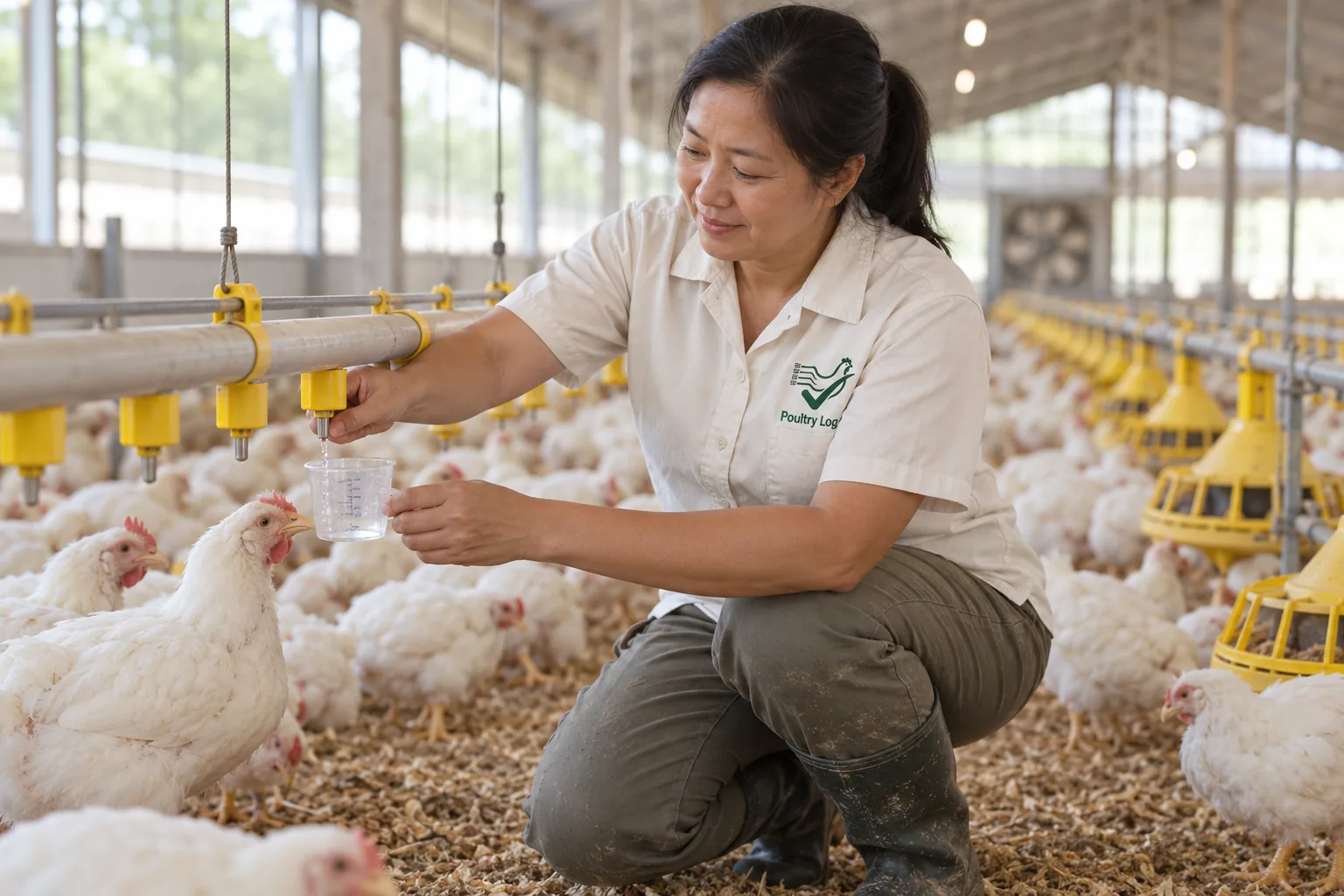
Drinking is the poultry behavior that carries the most operational weight and the least attention — birds drink roughly 1.6 to 2 times their feed intake by weight across the grow-out (the water guide's ratio story), and every physiological process that turns feed into meat or eggs runs on that water. The behavior itself is simple: birds drink in short bouts throughout the day, more in heat, more with pelleted feed. What makes drinking operationally significant is what the record shows: intake responding to problems — heat, water failure, disease — before feed intake, weight, or visible symptoms do. This page covers what drinking does for the flock, what changes intake, and why the water record is the earliest warning system a poultry operation has.
What Drinking Does
| Function | What It Does For The Flock |
|---|---|
| Digestion support | Birds will not eat without water — intake drops within hours of water restriction, which is why a drinker failure shows up in the feed record before it shows up anywhere else (the off-feed guide covers the water-first diagnostic) |
| Temperature regulation | Poultry cannot sweat — panting evaporates water from the respiratory tract; heat-stress response is fundamentally a water-balance crisis (the heat stress guide covers the response bands) |
| Nutrient transport | Every amino acid, vitamin, and mineral moves to where it is used dissolved in water — the transport layer under the protein guide's nutrition story |
| Egg formation (layers) | An egg is roughly 75% water — laying hens drink about twice non-laying birds at the same temperature, which is why the layer feed guide's water story runs alongside its feed story |
What Changes Intake
- Temperature — the largest normal driver. Hot days spike water intake hours before feed intake drops, which is why the water record reads the heat before the birds show it.
- Water quality. Biofilm, high mineral content, pH extremes, and contamination suppress intake gradually enough to read as "normal variation" — the water quality guide covers what to measure; the line cleaning guide covers what to fix.
- Drinker function. Nipple pressure, height, line level, and pump failures — the mechanical side; a single house with a pressure problem reads as a flock with an intake problem (the off-feed guide covers the water-first check).
- Feed form. Pelleted feed increases water demand relative to mash — a form change shifts the curve without any health change (the form guide covers the pairing).
The Money Connection
Every day of suppressed water intake is a day of suppressed feed intake — the growth bands guide prices what that costs at catch, and the egg profit guide's per-dozen math absorbs what it costs in laying flocks. The feed budget guide's framing applies through the water line: the cheapest intervention in poultry is the drinker that keeps flowing, and the most expensive is the failure nobody noticed until the feed chart showed it. The margin framing scales the same economics from coop to commercial house.
Tracking Water In Poultry Log™
Water logs with time-of-day and house let intake be read against the chart on the timeline — the record that turns "the birds seem fine" into a measured statement, and the earliest warning system the operation has. The early-warning guide covers the pattern-reading; the profitability dashboard carries what the water record protected across flocks.
- 2026-10-06: Comprehensive rewrite — function table (digestion, thermoregulation, transport, egg formation) and intake-drivers section with early-warning framing — replacing the earlier boilerplate version.
- Earlier version: short first-person note on the drinking habit.