
Water is the nutrient poultry consumes most of and measures least — broilers drink roughly 1.6 to 2 times their feed intake by weight across the grow-out, and every physiological process that turns feed into meat runs on it: digestion, nutrient transport, temperature regulation, and egg formation. A bird that stops drinking stops eating within hours; a flock with restricted water access loses performance before anyone notices the drinker line. This page covers water as a nutrient — how much birds actually drink, what quality factors change intake, and why the water record is the earliest warning system a poultry house has.
What Water Does In The Bird
| Water's Role | What Happens Without It |
|---|---|
| Digestion and feed intake | Birds will not eat without water — intake drops within hours of water restriction, which is why a drinker failure shows up in the feed chart before it shows up anywhere else |
| Nutrient transport | Every amino acid, vitamin, and mineral moves to where it is used dissolved in water — protein synthesis stops with circulation |
| Temperature regulation | Poultry cannot sweat — panting evaporates water from the respiratory tract; heat stress is fundamentally a water-balance crisis (the heat stress guide covers the response) |
| Egg formation (layers) | An egg is roughly 75% water — laying hens drink about twice non-laying birds at the same temperature |
How Much Birds Drink
Broiler water intake runs roughly 1.6-2 times feed intake by weight across the grow-out — on the example flock's feed curve, that means water intake climbing from a fraction of a gallon per thousand birds per day in week 1 to several gallons per thousand per day in week 6. The exact curve is temperature-dependent: hot days spike water intake hours before feed intake drops, which is why the water early-warning guide treats the water record as the first signal. The water consumption chart gives the reference; the feed chart beside it shows the ratio that confirms both are working.
What Changes Water Intake (Besides Thirst)
- Water quality. Biofilm, high mineral content, pH extremes, and contamination suppress intake — often gradually enough that the drop reads as "normal variation" until it compounds (the water quality test guide covers what to measure; the line cleaning guide covers what to fix).
- Drinker function. Nipple pressure, height, line level, and pump failures are the mechanical side — a single house with a pressure problem reads as a flock with a intake problem (the off-feed guide covers the water-first diagnostic).
- Feed form. Pelleted feed increases water demand relative to mash — a form change shifts the water curve without any health change.
- Temperature. The largest normal driver — and the one that makes the water record a heat-stress early-warning system: intake spikes precede panting by hours.
Why The Water Record Is The Earliest Warning
Water intake responds to problems before feed intake, weight, or visible symptoms do — a drinker failure, a heat event, or a health problem shows up in the water record first. A flock drinking 15% below curve on a normal day is a flock with a problem nobody has named yet. The early-warning guide covers the pattern-reading method; the cause-signature table shows what precedes mortality events. On the money side, every day of suppressed water intake is a day of suppressed feed intake — the growth bands guide covers what that costs at catch.
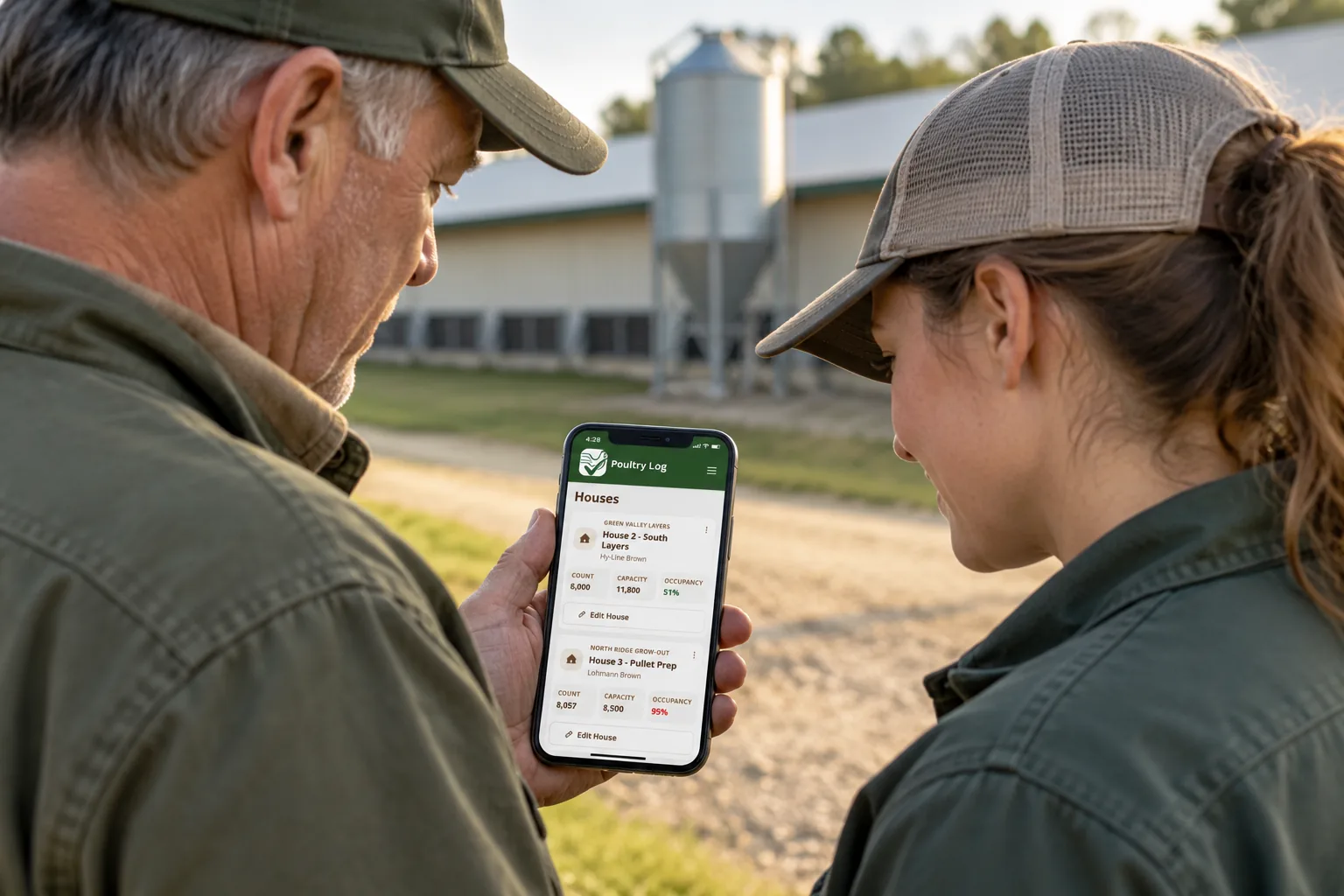
Tracking Water In Poultry Log™
Water logs in Poultry Log™ carry gallons, time-of-day, and house — the record that makes the early-warning method work. Intake against the water chart is visible weekly, with the feed, weight, and mortality records on the same timeline when a pattern needs explaining. The display unit defaults to gallons; the profitability dashboard carries what the water record protected across flocks.
- 2026-10-06: Comprehensive rewrite — water-roles table, intake-ratio explanation, quality/intake factors, and early-warning framing — replacing the earlier boilerplate version.
- Earlier version: short first-person note on water as a nutrient.