
Pellets versus crumbles is a feed-form question with a simple rule: match the form to the bird's ability to eat it, not to the price per ton. Pellets are compressed feed that reduces waste and improves intake in adult birds; crumbles are pellets broken into smaller pieces for birds whose beaks cannot handle full pellets yet — chicks in the starter phase, and sometimes smaller birds in transition. Both outperform mash on intake and waste for birds big enough to handle them, because compressed feed means every bite carries more nutrition and less lands on the litter. This page covers the form trade-offs, what each costs, and how form interacts with the feed cost picture.
The Form Trade-Offs
| Form | Best For | The Trade-Off |
|---|---|---|
| Pellets | Adult birds (grower, finisher, layer) — beaks large enough to pick up whole pellets | Higher processing cost per ton; the intake and waste gains usually more than pay for it in birds big enough to benefit |
| Crumbles | Chicks and small birds — starter phase and transitions | Same nutrition as pellets, smaller pieces; a crumble that is really just broken pellets with too much fines is a form failure, not a form choice |
| Mash | Any age where form processing is unavailable or uneconomical; some specialty programs choose it deliberately | Lowest intake efficiency and highest waste for birds that could handle pellets — birds sift the fine particles and leave them |
What Form Actually Changes
- Intake rate. Pelleted feed is eaten faster and more completely — birds spend less time eating and more time growing. Mash makes them work for each unit of nutrition.
- Waste at the pan. Fine particles from mash and over-crumbled pellets are the classic litter contaminant — wasted feed is the most expensive feed on the farm, and it degrades litter quality as it breaks down (the litter ammonia guide covers what that costs).
- Dust and respiratory load. Mash and degraded pellets raise airborne dust in the house — an air-quality cost that shows up in the respiratory symptom guide's checklist.
- Conversion. The cumulative effect of intake and waste lands in FCR — the FCR guide covers the benchmarks, and the feed chart shows the intake curve form is measured against.
Form Economics
Pelleting and crumble processing add cost per ton — the question is whether the intake and waste gains exceed it, which they typically do for birds large enough to benefit. The honest comparison: a pelleted finisher at a higher price per ton often delivers a lower cost per pound produced than mash at a lower price, because more of what you buy gets eaten and converted. The feed budget guide frames the per-flock math; the break-even price shows what form efficiency does to the per-pound floor. For a grower, the practical check: walk the house and look at the pans — feed in the litter is the form decision being made for you.
Tracking Form In Poultry Log™
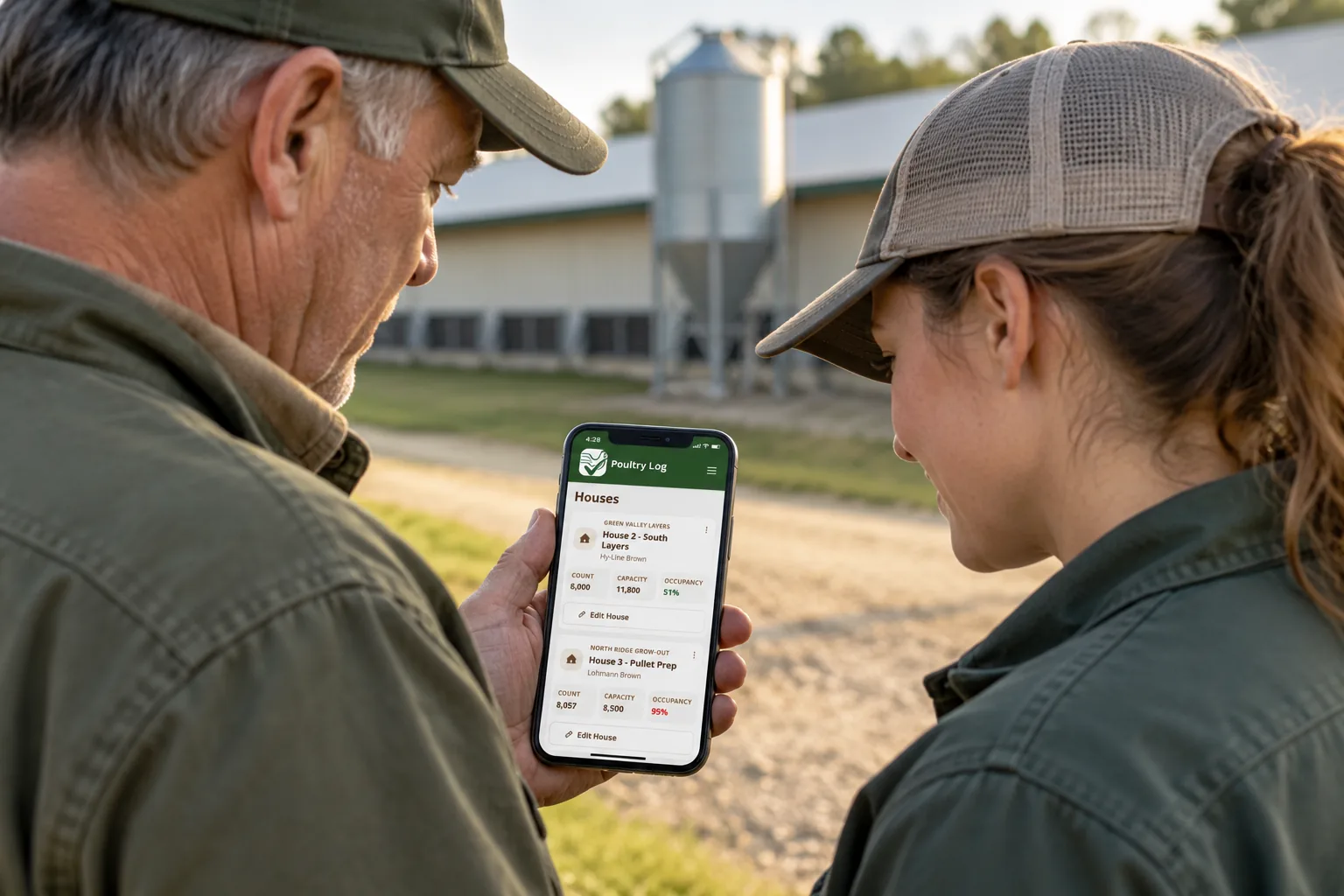
Feed deliveries logged by phase and weight — with the form noted — let pelleted versus mashed periods be compared on the same per-flock outputs: intake against the feed chart, conversion, and cost per pound produced. The profitability dashboard carries the trend across flocks.
- 2026-10-06: Comprehensive rewrite — form trade-off table, intake/waste/dust effects, and pelleting-economics framing — replacing the earlier boilerplate version.
- Earlier version: short first-person note on pellets vs crumbles.