
Layer feed — the ration that carries a laying flock through its production life — comes in phase-specific forms: pre-lay (pullet) feed that develops the body and reproductive system before the first egg, layer feed for peak and sustained production, and sometimes molting or post-peak programs. The phase transitions matter because the requirements shift: pre-lay feed builds frame and calcium reserves without triggering early lay; layer feed carries the production-level protein, the full calcium load with particle-size discipline, and the premix that shell quality depends on. This page covers the layer feed phases, what each does, and how phase discipline connects to the economics of egg production.
The Layer Feed Phases
| Phase | What It Does | What Goes Wrong If Skipped |
|---|---|---|
| Pre-lay (pullet) | Develops body frame, skeletal structure, and calcium reserves before the first egg; protein and calcium rise gradually as sexual maturity approaches | Early lay on an underdeveloped body: small eggs, prolapse risk, depleted reserves — the calcium guide covers what shell quality reveals |
| Layer (peak and sustained) | Production-level protein (~16-18% typical), full calcium (3.5-4.5%) with particle-size timing, complete premix — the ration that carries daily lay | Production dips that trace to the ration rather than to health — the nutrition guide covers what egg production draws from the diet |
| Post-peak and molt programs | Managed nutrition through production decline and induced or natural molt — some programs restrict during molt to reset the reproductive tract | Molt without a program is unplanned production loss; the program itself is a deliberate economic decision against current egg prices |
Phase Discipline
- Transitions are stress points. Feed changes disturb gut handling and intake — the electrolytes guide covers the transition-window support some programs use; the feed chart's intake-drop logic applies to layers the same way.
- Wrong-phase feed is a silent cost. Layer feed fed to pullets triggers early lay; pre-lay feed fed to layers starves production. Both show up in the numbers before anyone connects them to the bin — feed deliveries logged by phase (the record discipline the budget guide describes) are what make the connection visible.
- Shell quality is the phase's report card. Thin shells in a flock that should be at peak point at calcium, D3, or the phase transition itself — the oyster shell guide and D3 guide cover the differential.
The Economics
Layer feed is the dominant cost of egg production — steady consumption against steady production makes the feed bill a per-dozen number rather than a per-flock one, which is how the egg profit guide frames the economics and how the pricing guide sets the cost-first floor for direct-market eggs. Phase discipline — right feed, right time, logged deliveries — is what keeps the per-dozen number where the budget put it. The organic feed guide covers the certified-program cost structure; the feed cost guide covers the leak discipline that applies to any poultry operation.
Tracking Layer Feed In Poultry Log™
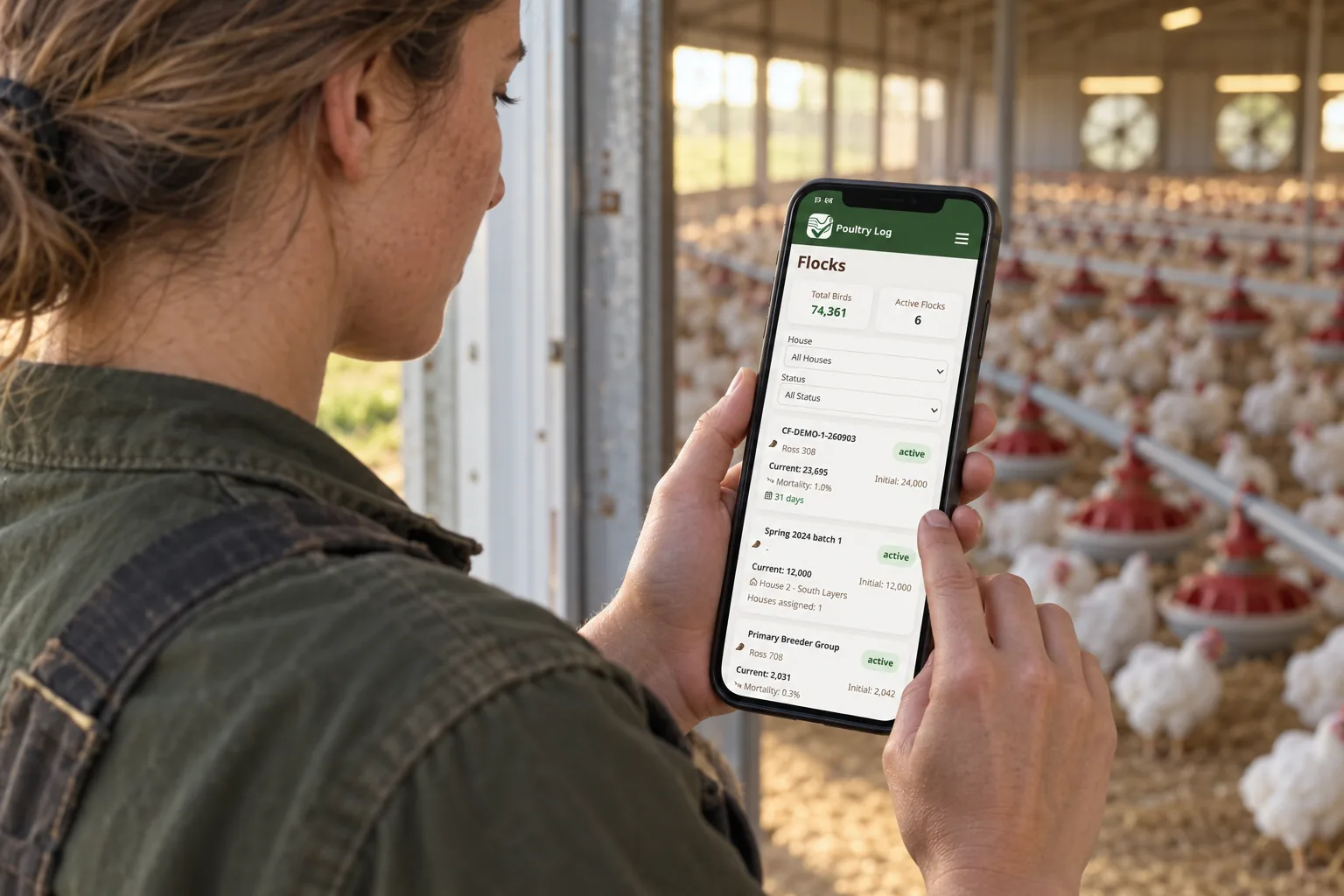
Feed deliveries logged by phase let the layer program's transitions be traced to their production effects on one timeline — feed consumed per dozen produced, per period, per flock. The nutrition guide covers the requirement architecture; the profitability dashboard carries what feed-program decisions did to margin across flocks.
- 2026-10-06: Comprehensive rewrite — phase table (pre-lay, layer, post-peak/molt), phase-discipline section, and per-dozen economics framing — replacing the earlier boilerplate version.
- Earlier version: short first-person note on layer feed for hens.