
A broiler flock moves through three phases, and each phase has one job that decides whether the next phase works: brooding (days 0–14) establishes the flock, the grower phase (days 14–28) builds most of the saleable weight, and the finisher phase (days 28–42+) converts weight into margin under rising feed costs. This page maps each phase to the breeder targets it must hit — weights, daily gain, feed intake, and FCR from the same 2022 Cobb 500 and Ross 308 objectives used across the growth chart cluster — and names the decision each phase demands before the next one begins.
The Three Phases at a Glance
| Phase | Days | Cobb 500 Target Weight | ADG Range | Phase Job |
|---|---|---|---|---|
| Brooding | 0–14 | 42 g → 470 g | 21 → 40 g/day | Establish feed, water, and gut — the start decides the curve |
| Grower | 14–28 | 470 g → 1,620 g | 72 → 92 g/day | Build weight at the best conversion — the gain engine |
| Finisher | 28–42+ | 1,620 g → 2,910 g | 81 → 103 g/day | Convert weight to margin while FCR allows — the most expensive pounds |
Source: Cobb-Vantress Cobb500 2022 performance objectives, mixed-sex, standard management. Ross 308 runs a few percent differently by week — see the growth chart for both breeds.
- Cobb-Vantress. Cobb500 Broiler Performance and Nutrition Supplement (2022). Download PDF
- Aviagen. Ross 308 Broiler Performance Objectives (2022). aviagen.com
Weeks 0–2: Brooding Decides Everything After It
The brooding phase runs on one rule: a chick that eats and drinks within hours of placement never falls behind permanently, and one that does never fully catches up. The targets are small but unforgiving — ADG should roughly double from week 1 (~21 g/day) to week 2 (~40–42 g/day). If week-2 gain is not double week-1, something in the brood failed: cold spots, drinker access, chick quality, or feed availability.
- Temperature: 90–95°F (32–35°C) at floor level for the first three days, dropping about 5°F per week — the brooding guide covers the full curve. Chick behavior is the truest sensor: evenly spread means right, huddled means cold, panting away from heat means hot.
- First-feed access: feed and water within reach of every chick from placement. Pan height and nipple height for day-old birds are the two most common access failures in week 1.
- Weigh at day 7: the first weigh-in is the brood's report card — see the weighing protocol. A day-7 average below 190 g (Cobb) means the next 7 days are recovery days, not growth days.
Weeks 2–4: The Gain Engine
This is where the flock earns its keep — ADG climbs from 40 to 92 g/day and cumulative FCR is at its best (1.10 → 1.34 for Cobb). Most of the bird's saleable weight is built here, and the environment that supports it is the one you set now: ventilation matching the rising moisture load, feeders adjusted as birds grow, and the water curve checked daily because water problems here show up as weight problems three days later.
The grower phase is also when uniformity quietly decides the catch. Access problems in weeks 2–3 create a wide flock that costs more to feed and grades worse — and by week 4 the spread is largely locked in. Weigh weekly, calculate CV%, and fix access while the birds can still recover.
Weeks 4–7: The Finisher Is a Financial Decision
The finisher phase delivers the peak ADG (~103 g/day at week 6) on the worst feed conversion — cumulative FCR climbs from 1.34 to 1.80, and the incremental cost of each pound of gain rises with it. At $0.50/lb feed, a week-7 pound of gain costs about $1.30 in feed alone versus $0.74 in week 4. This is why the finish is where catch timing, contract weight bands, and the catch economics all converge: the phase job is not "grow more," it is "grow the pounds your contract will pay for, and stop before the ones it will not."
Phase Decisions: What Must Be Settled Before the Next Phase
| Before This Phase | Decision to Settle | If You Get It Wrong |
|---|---|---|
| Grower (day ~14) | Brood held? Weight on curve? Ventilation scaled for moisture load? | Weeks 2–4 become recovery, not growth — the most expensive correction window |
| Finisher (day ~28) | Uniformity acceptable? Contract weight band known? Catch-date economics run? | Wide flock caught late; feed spent on pounds the contract will not pay for |
| Catch (day ~42) | FCR position vs complex average? Projected settlement vs break-even price? | Flock caught on the calendar instead of on the margin |
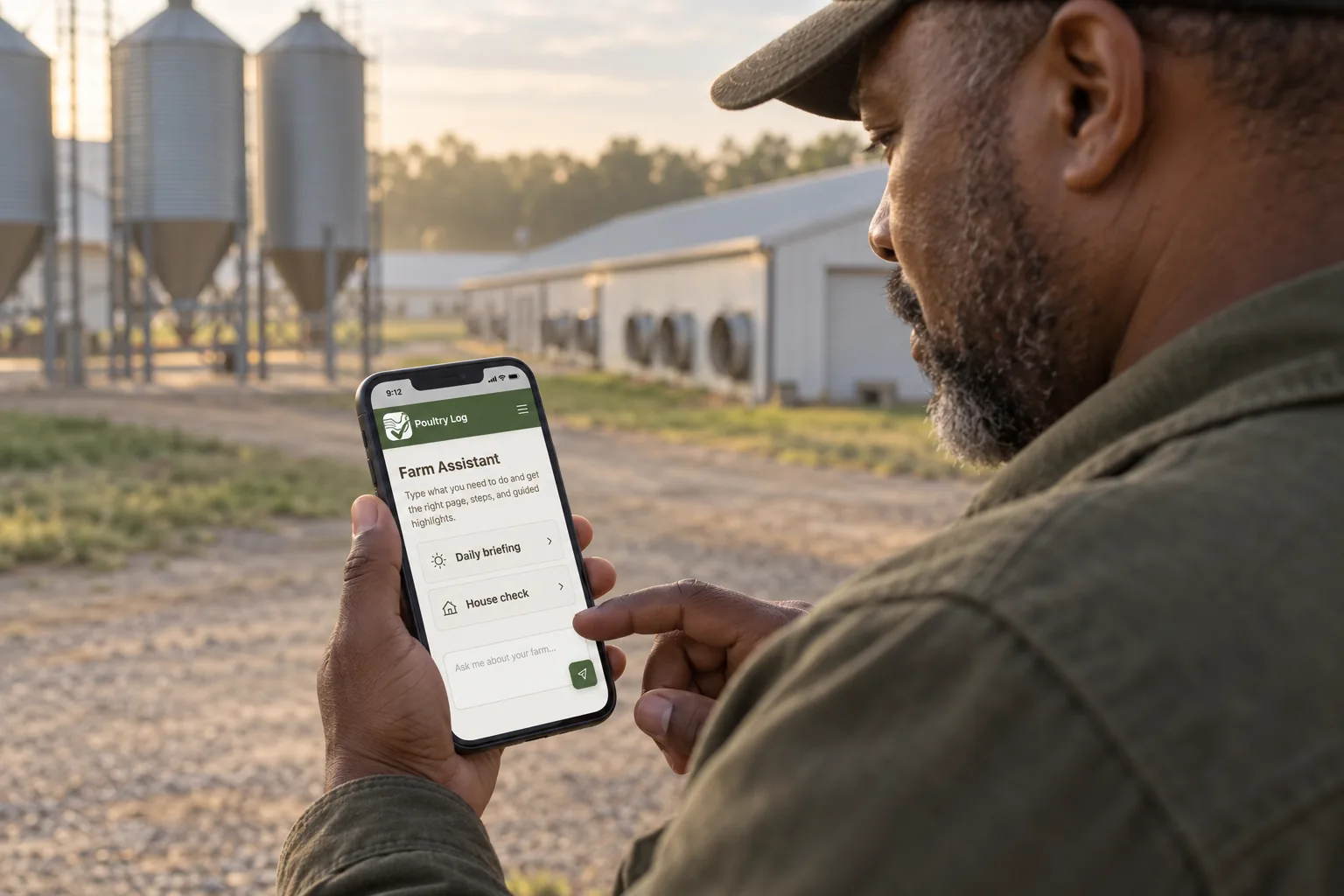
Tracking Growth Stages in Poultry Log™
Weekly sample weights logged per house compare against the phase curve automatically — so a brood that did not hold or a grower-phase stall surfaces while the phase decision is still open. Feed, water, and mortality on the same timeline turn "behind target" into a named cause, and each flock's phase history feeds the profitability dashboard, where you can see which phase of which season actually earned the margin.
- 2026-10-05: Comprehensive rewrite. Phase-by-phase targets from 2022 breeder objectives, phase job framing, and the decision each phase demands — replacing the earlier short narrative version.
- Earlier version: brief prose overview of the three phases.