
Why Broiler Farm Management Matters More Than Ever
Running a profitable broiler farm is a margin business. With feed representing 60–70% of total production costs and settlement payments tied to tournament rankings, every management decision affects the bottom line. A 0.1-point improvement in FCR on a 20,000-bird house can mean thousands of dollars in additional income over a year of flocks.
Broiler farm management covers five core areas: brooding, grow-out nutrition, house environment, flock health, and record keeping. Each area is interdependent — poor ventilation affects feed intake, which affects FCR, which affects settlement. Growers who master all five consistently outperform their peers.
The Five Pillars of Broiler Management
1. Brooding — The First 14 Days Determine Everything
The brooding period is the most critical phase of any flock. Day-old chicks cannot regulate their own body temperature, so house temperature must be maintained at 90–95°F (32–35°C) for the first three days, then reduced by about 5°F per week. Chick behavior is the most reliable thermometer: evenly distributed chicks mean the temperature is right; chicks huddling under heaters mean they are cold; chicks panting away from heat sources means they are too hot.
First-week mortality should be under 1.5%. Exceeding that threshold usually points to a brooding problem — incorrect temperature, poor air quality, or inadequate feed and water access. Brooding mistakes compound over the life of the flock and are almost impossible to fully recover from.
2. House Environment — Air, Litter, and Light
Broiler house ventilation is the most important system on the farm. In cold weather, minimum ventilation removes moisture and ammonia while preserving heat. In warm weather, tunnel ventilation provides wind-chill cooling that can reduce effective bird temperature by 10–15°F. A well-managed ventilation system keeps ammonia below 10 ppm, litter moisture under 30%, and oxygen levels adequate for bird health.
Litter quality affects foot pad health, ammonia levels, and overall bird comfort. Wet litter is the primary cause of foot pad dermatitis, a welfare issue that can result in processing downgrades. Managing drinker height and pressure, fixing leaks immediately, and maintaining adequate ventilation all contribute to dry, friable litter throughout the grow-out cycle.
Lighting programs also play a significant role. Broilers need at least 4–6 hours of continuous darkness per day after day 7 to support leg health and reduce metabolic disorders like sudden death syndrome. LED lighting is the standard choice for its energy efficiency and consistent light distribution.
3. Nutrition — Feed Is Your Biggest Cost
Feed management starts with choosing the right feeding program for your breed and target weight. Most operations use a three-phase program: starter (days 0–10 or 14), grower (days 14–35 or 38), and finisher or withdrawal feed for the last 5–7 days before processing. Each phase delivers a different nutrient profile matched to the bird's changing needs.
Tracking daily feed consumption is essential for calculating FCR accurately. Feed deliveries should be logged as they arrive, and feed line management — keeping lines filled and functioning properly — ensures all birds have equal access. A feed outage of even a few hours can cause uneven growth that shows up at processing.
4. Flock Health — Observation Is Prevention
Daily observation is the foundation of broiler health management. The earliest sign of trouble is almost always a change in water consumption. A 10–20% drop in water use can signal disease or environmental stress before mortality increases. Training workers to recognize early signs — respiratory sounds, uneven distribution, changes in droppings — turns every walkthrough into a health check.
A proper vaccination program protects against Newcastle disease, Infectious Bronchitis, Gumboro, and coccidiosis. Biosecurity protocols — Danish entry systems, dedicated house footwear, pest control, and all-in all-out flock management — prevent disease introduction. When disease does occur, rapid diagnosis and treatment minimize the impact on flock performance.
5. Record Keeping — The Difference Between Guessing and Knowing
Good record keeping ties everything together. Daily mortality counts, water meter readings, feed delivery logs, house temperature records, treatment documentation, and equipment maintenance notes create a complete picture of each flock's performance. Without records, growers are making decisions based on memory and intuition — and the margin for error is too thin for guesswork.
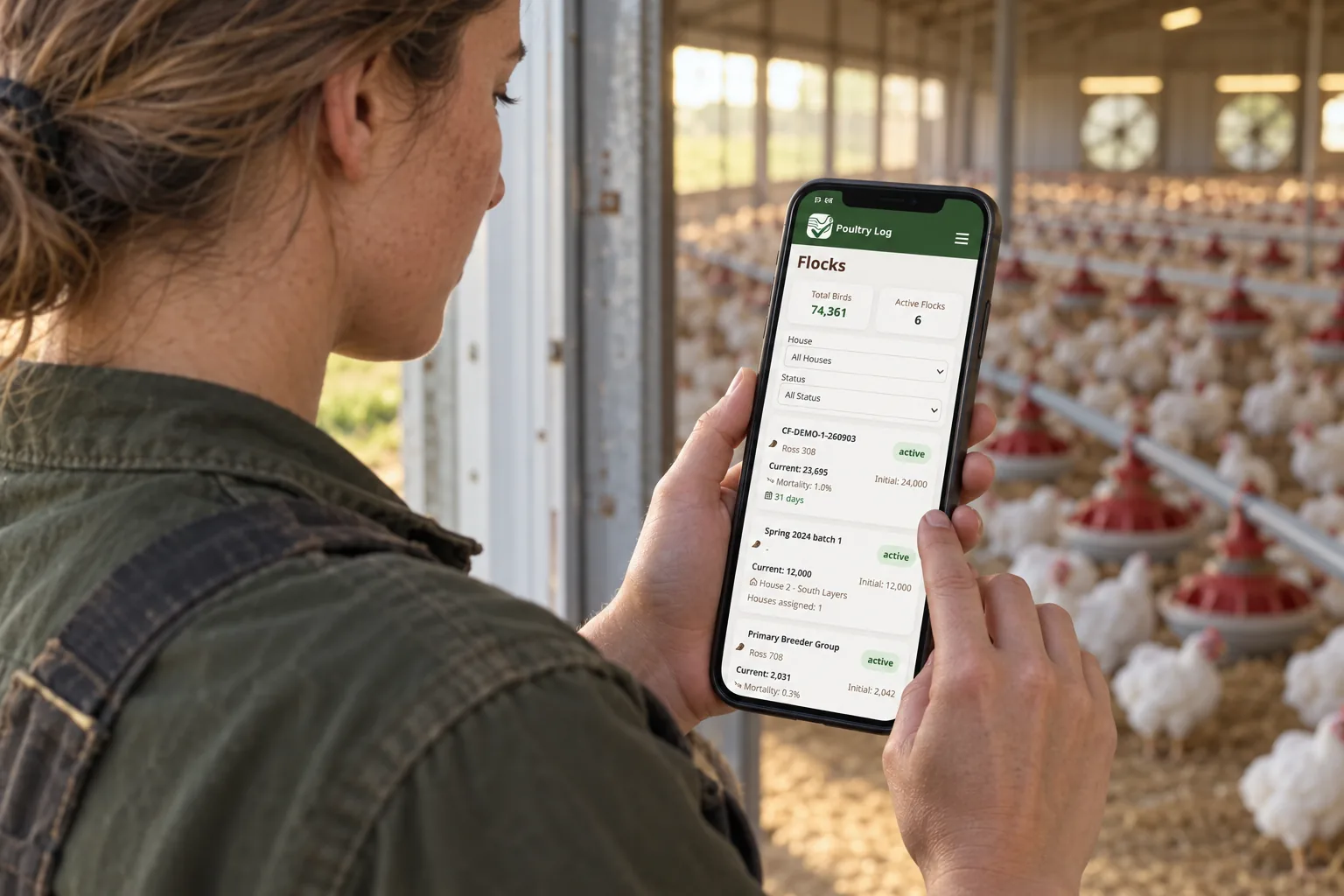
A structured record keeping system allows growers to compare performance across flocks and houses, identify top and bottom performers, calculate true cost per bird, and present organized documentation during audits. The best systems make logging faster than paper and deliver insights through trend charts and automated reports.
Common Management Mistakes That Cost Money
Even experienced growers make mistakes that eat into profits. The most common include inconsistent brooding temperatures that create uneven starts, inadequate minimum ventilation that allows ammonia to build up, delayed response to water consumption drops, poor feed tracking that leads to inaccurate FCR calculations, and scattered record keeping that makes compliance stressful and trend analysis impossible.
The most profitable growers share a common approach: they treat record keeping as an essential management tool, not a compliance chore. They track daily data consistently, review trends between flocks, and use what they learn to make better decisions for the next placement. That is the difference between farming by memory and farming with evidence.
Management Resources by Topic
- Brooding guide — temperature, feed, and water setup for the first 14 days
- House management — ventilation, temperature, and litter control
- Feed management — starter, grower, and finisher programs
- Record keeping — what to track and how to organize it
- Growth chart — weekly weight and feed targets by breed
- FCR guide — understand and improve feed conversion
- Profitability guide — turn records into money decisions
- Cost per bird — calculate and track true cost per flock
- Budget template — plan costs and break-even before placement
- Settlement calculator — project your settlement payment