
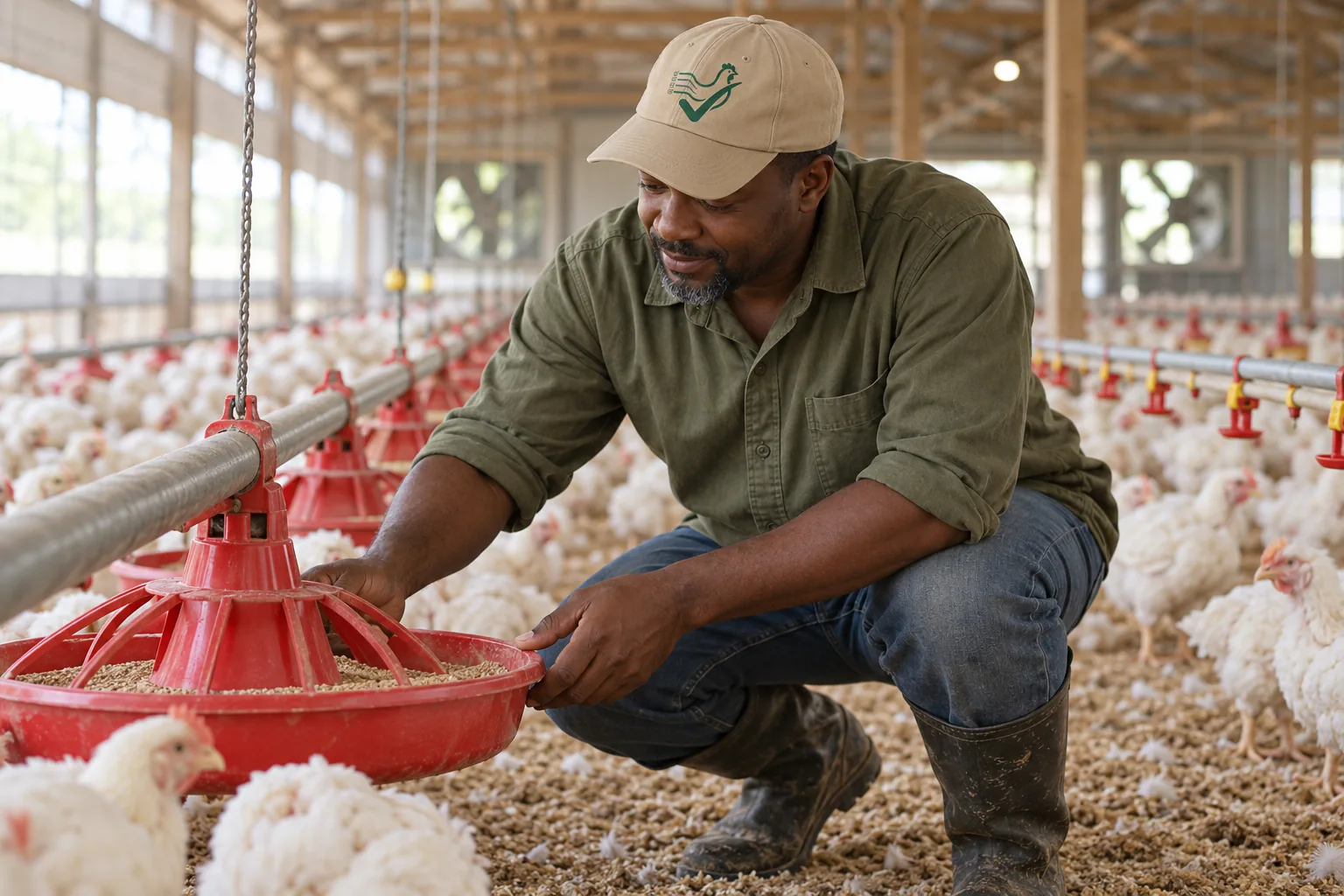
Broiler feed formulation is the practice of balancing energy, protein, amino acids, and micronutrients across three feeding phases so each bird gets what its growth stage demands — and for most contract growers, the formulation itself arrives from the integrator or mill. What the grower owns is phase integrity: the right feed, in the right bin, on the right days. This page covers how the phases differ, when to transition, and the delivery and storage errors that turn a correct formulation into a wrong result in the bird.
The Three Phases: What Changes Between Them
| Phase | Typical Window | What the Formulation Does | Grower's Check |
|---|---|---|---|
| Starter | Placement to ~day 10–14 | Highest nutrient density — energy and protein/amino acids peak to support the brooding growth curve (ADG roughly doubling by week 2) | Every chick reaches feed and water within hours of placement; pan height correct for day-old birds |
| Grower | ~day 14 to ~day 28–35 | Density steps down as intake rises — the bird eats more pounds of feed to build the same gram of gain | Transition on the intake curve and FCR, not the calendar alone; watch for the intake dip that signals a phase change went early or late |
| Finisher | ~day 28/35 to catch | Lowest density — birds are converting, not growing structure; the feed chart shows intake peaking near week 6 | Confirm catch-window economics before feeding finisher past the plan — see the catch chart |
The pattern across all three: nutrient density falls while intake rises. That is the design — the bird's daily nutrient need is met by more pounds of a lighter feed as it grows, which is also why phase transitions are the moments where intake and conversion are most sensitive to error.
When to Transition: The Grower's Decision
If your program specifies phase dates, follow them — but verify them against what the birds are doing. The signal to watch is the daily intake curve: a flock eating ahead of the curve may be ready for the next phase early; a flock eating light may need the current phase a day or two longer. The ADG chart cross-checks the other side — gain per day should be climbing toward the phase target, not flat. Transition decisions made on the birds' actual numbers, within the bounds of your contract, are worth more than calendar dates.
The Errors That Happen After the Mill
- Wrong phase delivered. The most expensive formulation error, and the cheapest to catch: weigh or count every delivery against the ticket, verify the phase marking, and confirm it went in the right bin — on arrival, not when the birds stop eating. See the feed delivery errors guide.
- Stale feed left too long. Nutrient values decline with storage time, moisture, and heat. First-in-first-out rotation and bin inspections protect the formulation you paid for. The feed cost guide covers storage losses in detail.
- Medicated feeds and withdrawal periods. Medicated rations carry withdrawal windows that must end before catch — missing that is a food-safety failure, not a performance one. Record batch numbers and dates per the integrator records standard.
- Cross-contamination between bins. Grower feed in a starter bin, or two phases mixed, produces a ration that matches nothing on the label. dedicated equipment or cleaning between phases when bins are shared.
Formulation Errors Show Up as Performance
When the feed in the bird does not match the phase, the first symptom is intake — the birds either eat more than the curve (density too low for the age) or less (palatability, transition stress, or an error the other way). The second symptom is conversion: FCR drifts off the breeder curve while weight falls behind the growth bands. Weekly FCR from your own logs — feed consumed divided by weight gained — is the diagnostic that catches formulation-side errors within a week instead of at settlement, when the settlement calculator reveals them at full price.
Tracking Feed Phases in Poultry Log™
Feed deliveries logged with phase, weight, and bin — the day they arrive — make phase integrity checkable instead of assumed. Weekly consumption against the target curve, FCR from your own records, and weight from the weighing protocol sit on one timeline, so a phase error shows up as a paired intake-and-gain deviation with the delivery that caused it visible in the same view. The flock's feed history then feeds the profitability dashboard as cost per pound produced — the number that tells you whether the formulation, the price, or the birds decided the margin.
- 2026-10-05: Comprehensive rewrite. Phase-structure table, transition method, post-mill error list, and performance-signature framing — replacing the earlier short overview.
- Earlier version: brief note on balancing energy, protein, and micronutrients.