
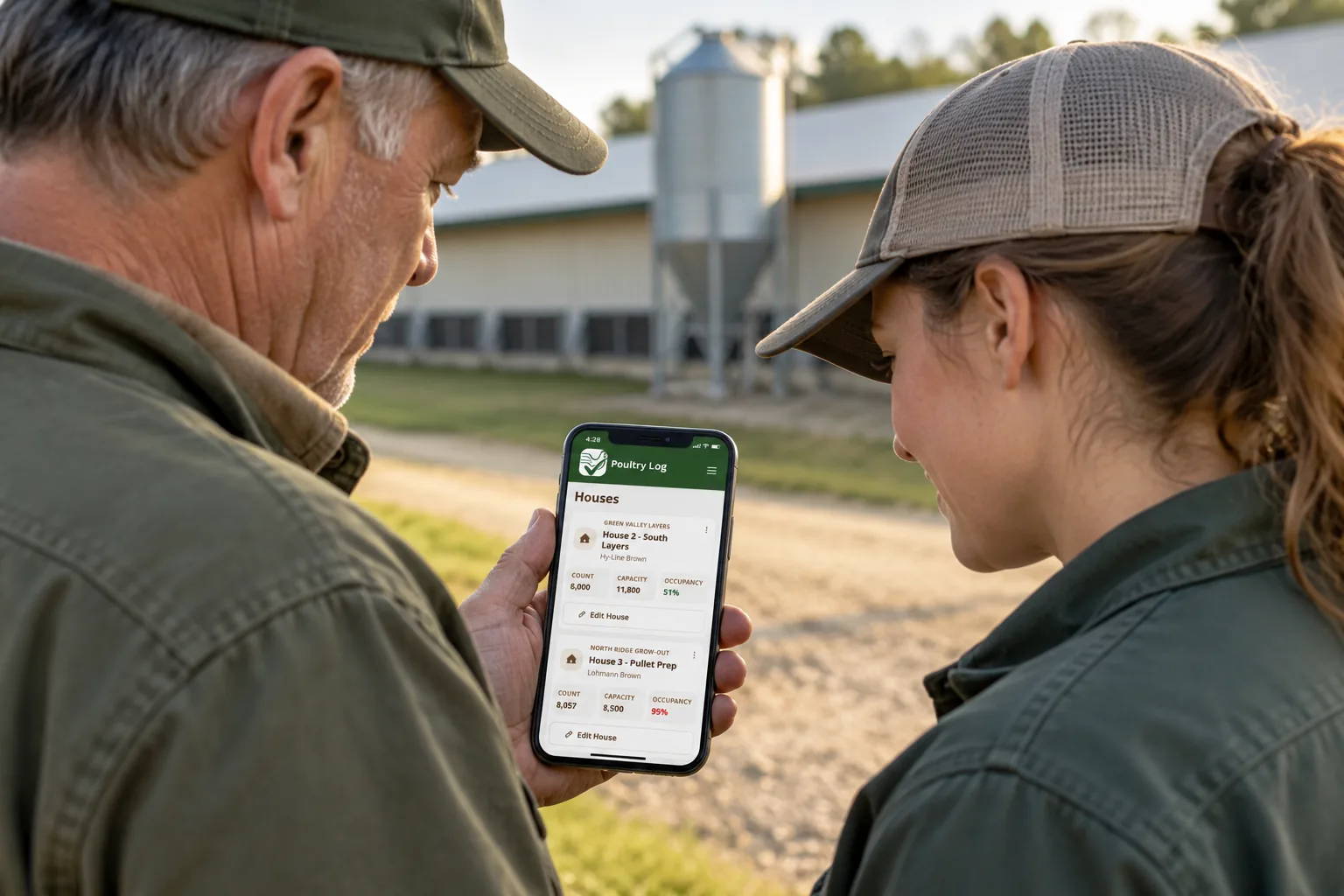
Every contract broiler grower in the United States works inside a record-keeping system whether they chose one or not. Tyson, Perdue, Pilgrim's, Mountaire, Fieldale, Wayne-Sanderson Farms, Koch Foods, and global producers like CP Foods (Charoen Pokphand Foods) run grower programs that specify what must be recorded, when, and for how long — because their own food-safety, welfare, and performance obligations depend on it. This page is the overview of what integrator programs typically require from growers, why each record exists, and what gets a grower flagged — built so you can build the record set once and keep it for every program you work under.
What Records Do Integrators Typically Require from Growers?
The standard record set across contract broiler programs has the same spine everywhere, because the obligations behind it are the same: food safety traceability, animal welfare compliance, environmental stewardship, and performance verification against settlement. Here is the record set, what each captures, and why the integrator wants it:
| Record | What It Captures | Why the Integrator Wants It |
|---|---|---|
| Placement records | Chick source, count, date, house assignment, initial body weights | Traceability origin point; the denominator for every performance metric |
| Daily mortality and cull logs | Count by house, date and time, suspected cause, disposal method | Disease surveillance (reportable conditions), welfare compliance, flock performance review |
| Water consumption records | Daily meter readings by house, deviations noted | Early disease signal, environmental management evidence, water-use compliance |
| Feed delivery and usage | Tickets by delivery — date, weight, phase, bin — plus consumption tracking | Drug and additive withdrawal verification, cost reconciliation, FCR verification |
| Treatment and medication records | Product, batch number, dose, route, dates treated, withdrawal period end date | Food safety: residue prevention is the single most audit-critical record on the farm |
| Vaccination records | Product, date, method, batch, birds treated | Disease program verification, hatchery and integrator health coordination |
| Environmental records | Temperature, ventilation settings, ammonia or litter checks where required | Welfare compliance (ventilation, thermal comfort), environmental permit conditions |
| Equipment and service logs | Repairs, parts replaced, calibration dates (scales, sensors), contractor work | Corrective-action evidence, audit readiness, biosecurity for contractor visits |
| Biosecurity logs | Visitor sign-ins, vehicle and equipment sanitation, down-bird procedures | Disease exclusion — the record set that protects the whole complex, not just your farm |
| Catch and load records | Load dates, bird counts by house, weights where recorded, truck and crew information | Settlement verification, plant receiving reconciliation, welfare during catch |
Why the Requirements Exist: The Obligations Behind the Paperwork
Integrator requirements are not arbitrary. Each record exists because the integrator carries obligations that run through the grower's farm:
- Food safety and traceability. USDA FSIS rules and integrator customer requirements demand that any bird entering the food supply can be traced back to its flock, its feed, and any treatments it received. Medication records with withdrawal dates are the records that keep a flock eligible for slaughter — an unverifiable withdrawal period means birds that cannot ship.
- Disease reporting. Reportable conditions — avian influenza, exotic Newcastle disease — trigger immediate state veterinarian notification. The daily mortality log with dates and signs is what makes early detection and accurate reporting possible. See the HPAI biosecurity records guide for the specific evidence layer.
- Welfare compliance. Customer and certification expectations (and, for EU operations, Directive 2007/43/EC) require records showing birds were kept in good condition: environmental management, mortality handling, and corrective actions.
- Performance verification. Tournament and settlement systems compare your flock's performance to the complex. The records are what make the comparison auditable from both sides — see the settlement reconciliation method.
- Environmental stewardship. Nutrient management, mortality disposal certification, and water-use reporting feed state and federal environmental obligations the integrator's permit chain depends on.
Who Sets These Requirements: The Integrator Landscape
The US broiler industry is concentrated: a handful of integrators contract with the majority of growers, and each runs its own grower program with its own record specifications on top of the shared spine above. The major programs a contract grower may work under or be benchmarked against include:
| Company | Context |
|---|---|
| Tyson Foods | Largest US poultry producer; grower programs span multiple brands and regions |
| Pilgrim's Pride | Major US integrator (JBS-owned); significant Southeast and Texas operations |
| Perdue Farms | Major integrator with documented welfare and antibiotic-stewardship programs |
| Mountaire Farms | One of the largest US chicken companies; Delmarva and Southeast operations |
| Fieldale Farms | Georgia-based integrator; part of the broader US broiler consolidated landscape |
| Wayne-Sanderson Farms | Formed in July 2022 when Cargill and Continental Grain completed their acquisition of Sanderson Farms and combined it with Wayne Farms — now one of the largest US poultry businesses |
| Koch Foods | Major Midwest and Southeast integrator |
| CP Foods (Charoen Pokphand Foods) | Thailand-based global poultry producer with operations across Asia, Europe, and the Americas — relevant to growers and processors working in international supply chains |
- Cargill. Cargill and Continental Grain Complete Acquisition of Sanderson Farms (July 22, 2022). cargill.com
What Gets Growers Flagged
Auditors and integrator reviewers see the same failures repeatedly. None of them are exotic:
- Undated entries. A mortality count with no date or time cannot support a disease investigation, a withdrawal calculation, or a settlement discussion. Timestamps are the difference between a record and a memory.
- Compiled-not-current records. Registers assembled the night before an audit are detectable — gaps filled with the same pen, same ink, same hand. Daily logging defeats this by making the audit a walkthrough, not a document hunt.
- Treatments without withdrawal end dates. The single most dangerous gap: birds treated near catch with no recorded withdrawal period create residue risk that stops loads.
- Feed tickets that never made it into the record. Without delivery tickets, feed usage, medication withdrawal windows, and FCR verification all lose their evidence base.
- Corrective actions with no follow-up note. Finding a wet litter corner and fixing it is good; recording the finding and the response with dates is what closes the loop at the next visit.
The pattern behind all five: the record exists in someone's head or pocket instead of in a system with dates attached. The fix is the same for every program — one daily logging habit that covers the spine above, kept in a system that timestamps and stores it. See the audit-ready records guide for the preparation method and daily crop records for integrators for the day-by-day detail.
Building the Record Set Once in Poultry Log
Poultry Log is built around exactly this spine: daily house logs (water, feed, mortality, culls, weights, notes) with time-of-day stamps, treatment and vaccination records with batch numbers, equipment service history, compliance checklists that can be structured to a region profile, and exports an auditor or integrator can read. One logging habit serves every program you work under — because the record set above is the same one settlement reconciliation, audit preparation, and tournament conversations all draw from. The settlement calculator and comparison method are where this record set starts paying back at the end of the flock.
- 2026-10-05: Initial version. Standard record set table, obligations behind each record, integrator landscape with verified Wayne-Sanderson Farms source, and common audit failures.