
Pricing poultry — for direct-market meat, eggs, or live birds — starts at your cost and works upward, not from what the neighbors charge backward. A price set from the market average without a cost floor underneath it is a guess dressed as a business decision; a price built from cost per pound plus a stated margin survives comparison, negotiation, and bad weather. This page covers the cost-first pricing method with a worked example, the margin decisions that are really positioning decisions, and the records that make every price defensible.
The Cost-First Pricing Stack
| Layer | Example: Broiler | Example: Dozen Eggs |
|---|---|---|
| Production cost per unit | $0.96/lb (broiler example flock) | $0.35–$0.50/dozen (layer inputs — feed, chicks, bedding, energy) |
| Add fixed-cost share | Already in the $0.96 figure | Divide monthly fixed costs by monthly dozens produced |
| Add desired margin | Contract-settlement margin — you choose cost control, not price | $0.50–$1.00+ per dozen for direct market, depending on channel |
| Add channel costs | Hauling to the dock, trucking | Market fees, packaging, fuel, your time at the stall |
| Price | Floor: $0.96/lb — plus your channel costs | Floor: your cost/dozen plus margin |
Margin Decisions Are Positioning Decisions
- The floor is fixed by your cost; everything above it is strategy. Two farms with identical $0.96/lb costs can price at $2.50 and $4.50 legitimately — the difference is channel, story, consistency, and what the customer can get elsewhere. What neither can do is price below cost and call it marketing.
- Weight bands change the math. A 4–5 lb bird has different feed efficiency and customer expectations than a 7–8 lb bird — price per pound and per bird separately, and check the market weight chart for what each band costs to produce.
- Seasonal cost movement must reach the price or the margin. Winter energy per dozen, summer feed-price spikes — if costs move and price does not, the margin absorbs the difference silently until it is gone. The margin guide covers the tracking side.
Price Discipline Habits
- Know your break-even per unit before setting any price — per pound for meat, per dozen for eggs. It is the number below which every sale costs money; the break-even guide covers the calculation.
- Review price when costs move, not annually. Feed-price movement of $0.05/lb adds roughly $0.045/lb to broiler production cost — a direct-market price that ignored it is now selling at reduced margin per bird.
- Record the price and channel for every sale. Which customers, which price, which channel — the pattern that shows whether the premium channel is actually premium after fees and travel. The selling direct guide covers the channel trade-offs.
Tracking Prices in Poultry Log™
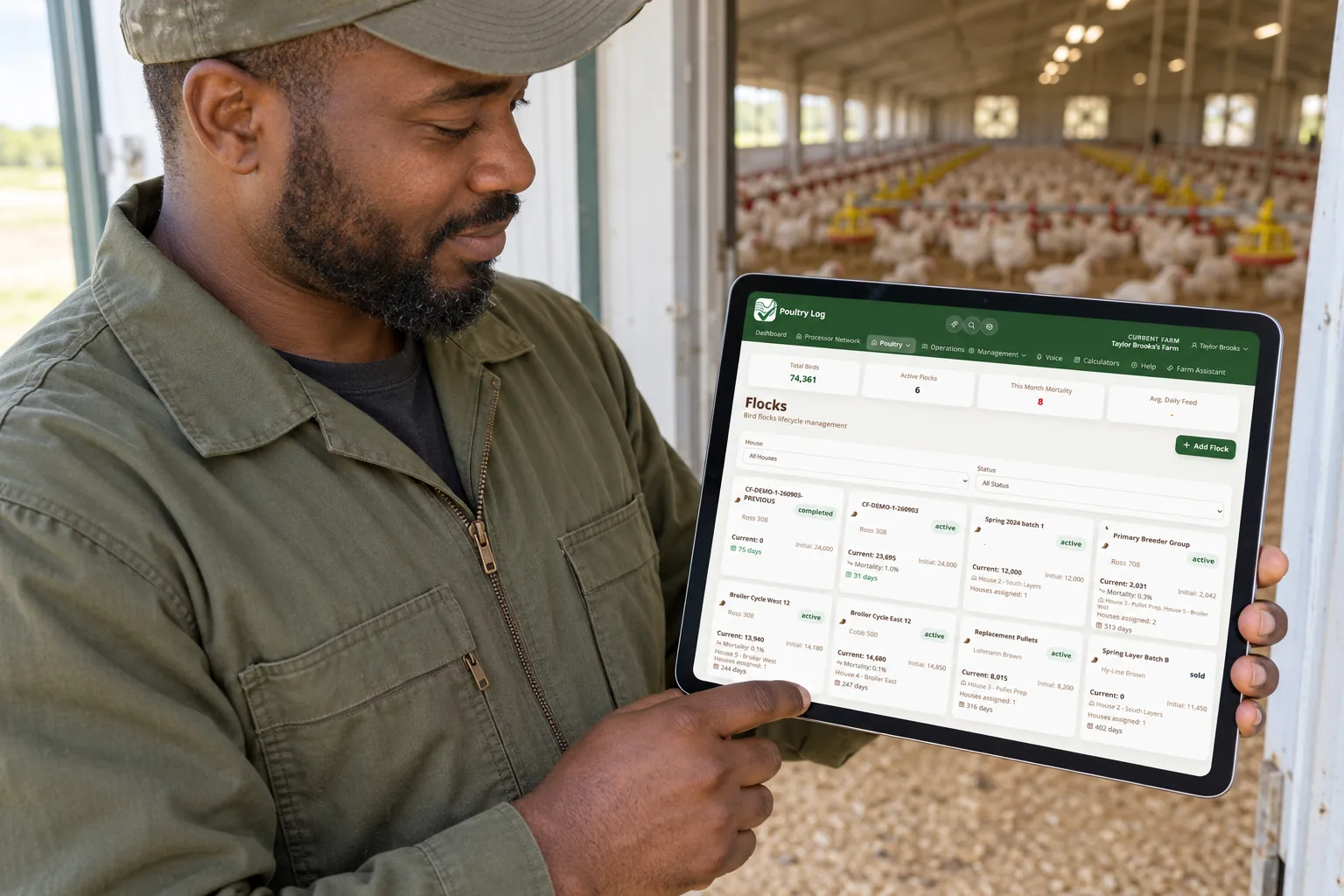
Sale records with price, channel, and quantity — tied to the flock and egg records that produced them — make the cost-to-price gap visible per sale, not per tax year. The profitability dashboard carries what the pricing choices did to margin across flocks; the settlement calculator covers the contract side of the same comparison; and the independent record of truth framing is what lets a grower state — with evidence — what a bird actually cost to raise.
- 2026-10-06: Comprehensive rewrite. Cost-first pricing stack with worked examples, positioning-framed margin decisions, and price-discipline habits — replacing the earlier boilerplate version.
- Earlier version: short first-person note on knowing your cost.