
Organic poultry feed is feed produced under organic certification standards — grown without synthetic pesticides or fertilizers, non-GMO by certification requirement, and produced in facilities that prevent commingling with conventional feed. For organic poultry production, the feed question is the cost question: organic corn and soybean meal typically carry a substantial premium over conventional counterparts, feed is 85-90% of production cost even in conventional programs, and the organic premium lands directly on the break-even price. This page covers what organic certification requires of feed, the cost structure that defines it, and the honest economics of organic poultry production.
What Certification Requires Of Feed
| Requirement | What It Means For The Feed Bill |
|---|---|
| Certified-organic ingredients | Corn, soybean meal, and other grains must be certified organic — the premium over conventional is the core cost driver (organic corn and soy typically carry meaningful per-ton premiums) |
| Non-GMO by certification | Organic certification excludes GMOs by rule — the GMO-free guide covers the separate (and differently priced) non-GMO claim |
| Additive restrictions | Only approved additives may be used — synthetic amino acids, certain preservatives, and most medications are excluded, which changes the formulation economics the methionine guide and lysine guide describe |
| Medication restrictions | Most synthetic medications are prohibited except for defined parasite-control exceptions — the medicated feed guide covers why this conflicts with conventional coccidiosis programs |
The Cost Structure
- Feed dominates, and the premium multiplies it. At 85-90% of production cost, an organic feed premium of even 20-40% over conventional lands directly on cost per pound — the feed budget guide's math applies unchanged, with a larger number in the feed line.
- Excluded tools cost performance. Synthetic amino acids, conventional coccidiostats, and some preservatives are off the table — the formulation has to hit the same performance targets with a narrower toolset, which affects conversion (the FCR guide covers what conversion differences are worth).
- The premium has to reach revenue. Organic certification only pays if the certification premium is captured at sale — the pricing guide covers the cost-first method, and organic certification is one of the few production claims with a well-established premium channel. The honest framing: organic is a marketing-position decision before it is a nutrition decision, and the economics work only when the premium channel is secured before the flock is placed.
The Honest Economics
Organic poultry production is a legitimate business when three conditions hold: the premium channel is contracted or demonstrably accessible, the operation can absorb the excluded-tools performance trade-offs, and the certification compliance burden (records, inspections, supply-chain documentation — the audit-ready guide covers the record discipline) is sustainable. Where those conditions do not hold, the organic feed premium is cost without corresponding revenue — the profitability dashboard's framing applies: the certification has to pay for itself in the margin, per flock.
Tracking Certified Programs In Poultry Log™
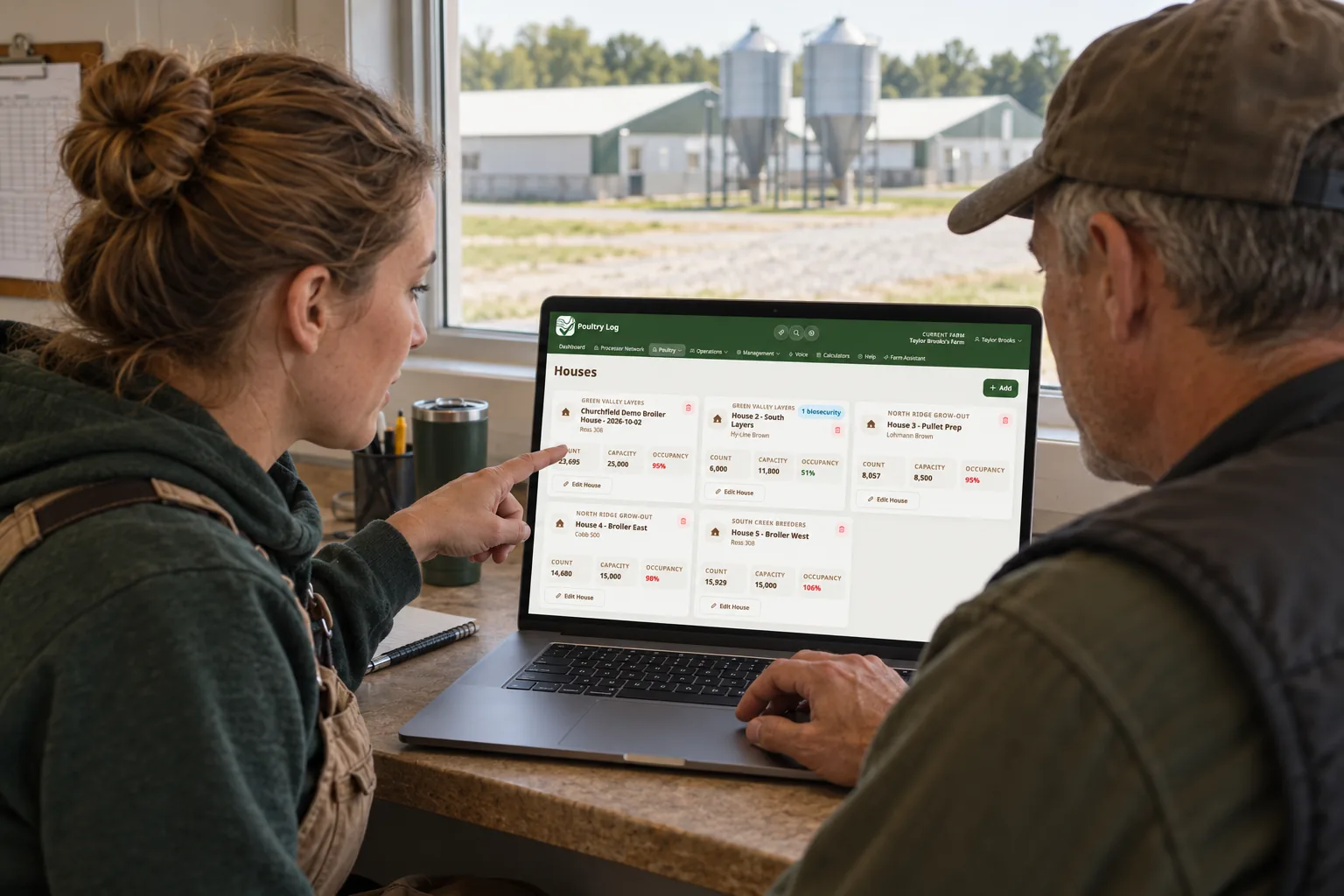
Feed deliveries logged by ingredient and supplier let certified-feed periods be traced to their documentation — the record that supports both the certification audit and the cost-per-pound comparison against conventional periods. The labeling guide covers what claims the finished product may carry.
- 2026-10-06: Comprehensive rewrite — certification-requirements table, cost-structure framing, and three-condition honest economics — replacing the earlier boilerplate version.
- Earlier version: short first-person note on organic feed.