
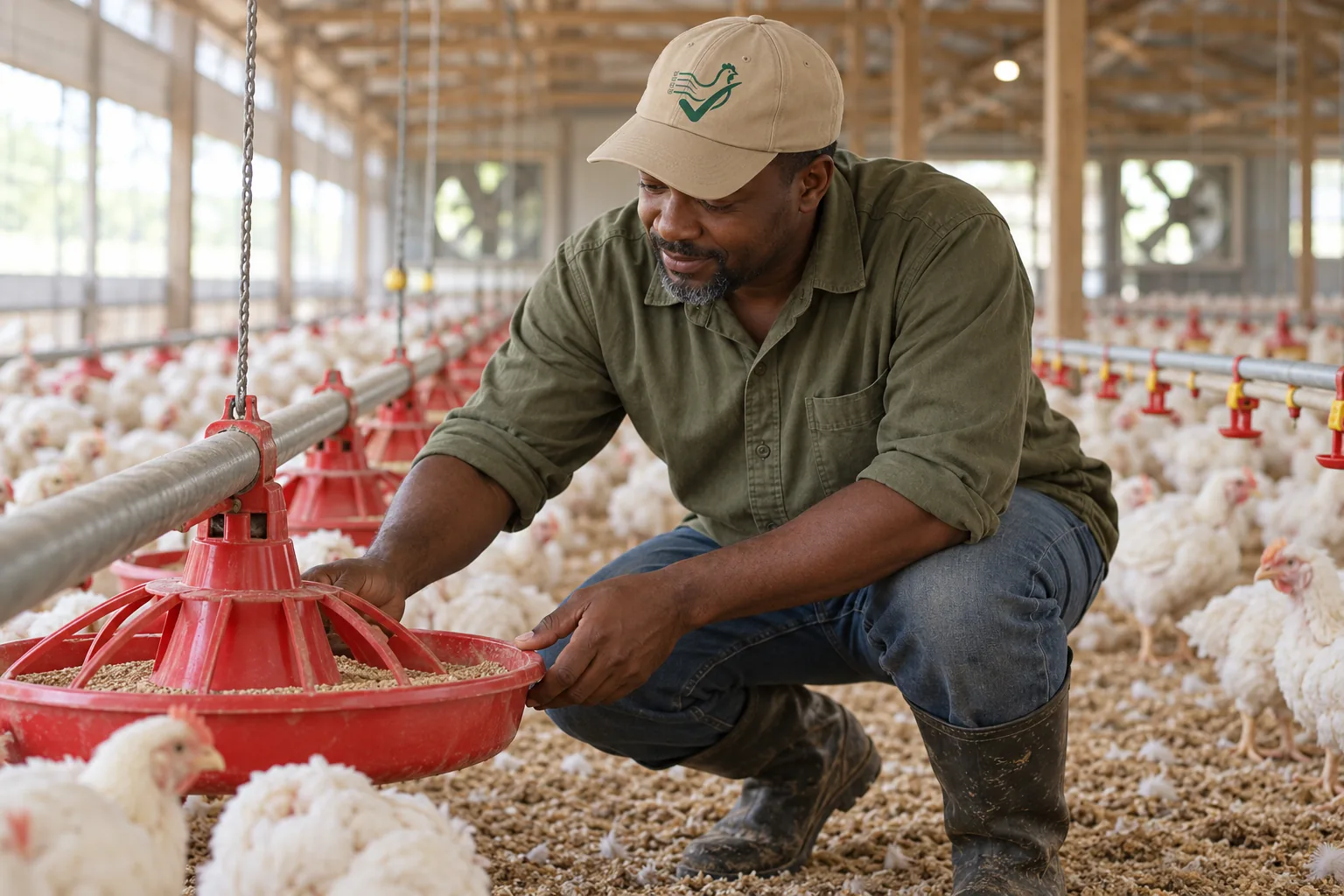
Grower feed is the middle broiler ration — the bridge between the starter phase's rapid development and the finisher phase's efficient gain, typically running about 20-22% crude protein (varies by strain, phase length, and the integrator's specifications). In the commercial three-phase program it covers roughly weeks 3-4, the period when the chick's digestive system matures, growth rate normalizes, and the bird's frame is built for the finisher's weight gain. This page covers what the grower phase does, how it connects the two phases around it, and what the middle of the grow-out reveals that the ends cannot.
What The Grower Phase Does
| Grower Characteristic | Why The Middle Phase Matters |
|---|---|
| Protein ~20-22% (typical commercial range) | Between starter (~22-24%) and finisher (~18-20%) — the requirement falls as the bird ages; the protein percent guide covers the full curve |
| Digestive system maturation | The gut finishes developing in this phase — feed efficiency improves as the bird's own machinery catches up to the starter's ambition |
| Frame before mass | Skeletal and structural growth precedes the finisher's weight gain — the growth chart shows the S-curve this phase sits on the steep part of |
| Intake escalation | Weekly feed consumption climbs steeply through the grower phase — the feed chart shows the curve; deviations here are visible while causes are still correctable |
What The Middle Reveals
- Health events surface here. Broiler health problems that were subclinical in week 1-2 often become visible in the grower phase — respiratory signs, litter problems, intake deviations. The cause-signature table covers what patterns to read; the off-feed guide covers the intake-drop diagnostic.
- Conversion becomes measurable. Starter FCR is noisy (small denominators, rapid change); grower FCR is the first trustworthy read on feed efficiency — the FCR guide covers the age benchmarks. A grower-phase conversion drifting above curve is the earliest reliable signal of a problem that will hit the finisher's cost per pound.
- Management consistency shows. Ventilation, lighting, water, and litter management decisions compound through the middle phase — the house management guide covers the systems; the middle phase is where their cumulative effect becomes visible in the numbers.
The Cost Reality
The grower phase carries roughly a fifth of cycle feed spend on the example flock — smaller than the finisher's volume but large enough that conversion drift here is real money. A 0.01 FCR increase across the grower weeks costs roughly $300-400 on a 30,000-bird flock at $0.50/lb feed — and it usually predicts worse in the finisher. The feed budget guide frames the phase-level math; the feed cost guide covers the leak side; and the break-even price shows what phase-efficiency movement does to the per-pound floor.
Tracking The Grower Phase In Poultry Log™
Feed deliveries logged by phase let the middle of the grow-out be measured where it matters: intake against the feed chart, conversion against the age benchmarks, and the deviation patterns that decide whether the finisher starts from a strong position or a recovery. The profitability dashboard carries the trend across flocks; the starter guide and finisher guide cover the phases this one connects.
- 2026-10-06: Body upgraded to contract standard — phase-characteristic table, middle-phase diagnostic value, and conversion-drift economics — replacing the earlier short version.
- Earlier version: ~600-word general note on grower feed.