
The Broiler House Is Your Most Important Asset
The broiler house environment is the single biggest factor influencing flock performance that the grower controls. Feed quality and genetics are determined by the integrator, but how the house is managed — ventilation, temperature, litter, lighting — falls entirely on the grower. A well-managed house consistently produces better FCR, lower mortality, and higher settlement checks.
Modern tunnel-ventilated houses represent a significant capital investment, typically $200,000–$400,000 per house including equipment. Maximizing the return on that investment requires understanding how the house environment affects bird physiology and managing it proactively rather than reactively.
Ventilation: The Most Critical System
Ventilation serves three purposes in a broiler house: oxygen supply, moisture removal, and heat management. The ventilation mode must match current conditions.
Minimum Ventilation
Used during cold weather when heat conservation is the priority. Minimum ventilation runs fans on a timer to remove moisture, ammonia, and carbon dioxide while minimizing heat loss. The minimum ventilation rate should be calculated based on house dimensions and bird age — typically 0.25–1.0 CFM per square foot of floor area. Running minimum ventilation too low allows ammonia and moisture to build up; running it too high wastes fuel and chills birds.
The key to effective minimum ventilation is negative pressure. Inlet openings must be adjusted to create the correct static pressure (0.08–0.12 inches of water column), which determines how well incoming air mixes with warm house air before falling to bird level. Poor inlet management is the most common minimum ventilation mistake growers make.
Tunnel Ventilation
Used during hot weather to create wind-chill cooling. Tunnel fans pull air lengthwise through the house at 400–700 feet per minute, reducing the effective bird temperature by 10–15°F below the actual air temperature. Tunnel ventilation should be used when house temperature exceeds 80°F (27°C) for adult birds.
Cooling pads are an essential complement to tunnel ventilation in most climates. When air is pulled through wetted cooling pads, evaporative cooling can reduce incoming air temperature by 10–20°F depending on humidity. Proper cooling pad maintenance — cleaning, scale removal, and pad replacement on a regular schedule — is essential for effective operation.
Transition Ventilation
Between minimum and tunnel modes, transition (or cross) ventilation uses side-wall inlets with tunnel fans or side-wall fans to provide moderate airflow. Managing the transition between ventilation modes as the day warms and cools is one of the most challenging aspects of broiler house management, particularly during spring and fall when temperature swings are largest.
Temperature Management
Broiler house temperature should be managed according to bird age and behavior. Starting at 90–95°F for day-old chicks and reducing by about 5°F per week, the target temperature for adult birds is 70–75°F (21–24°C). However, effective temperature — which accounts for wind chill from air movement — is more relevant than actual air temperature.
Birds that are too hot reduce feed intake, which reduces growth. Birds that are too cold increase feed intake to maintain body temperature, which worsens FCR. Managing temperature to keep birds in their thermal comfort zone — where they are neither panting nor huddling — optimizes both growth rate and feed efficiency.
Litter Management
Litter quality directly affects bird health and welfare. Target litter moisture is 20–30%. Litter above 30% moisture promotes bacterial growth, increases ammonia production, and causes foot pad dermatitis. Litter that is too dry (below 15%) creates dust problems that can irritate bird respiratory systems.
Key litter management practices include maintaining drinker line pressure at the correct level to prevent leaks, adjusting drinker height as birds grow, removing wet litter spots promptly, and using litter amendments (alum, sodium bisulfate) between flocks to reduce ammonia and condition the litter. Decaking between flocks — removing the compacted top layer of old litter — improves the next flock's starting conditions.
Tracking House Performance
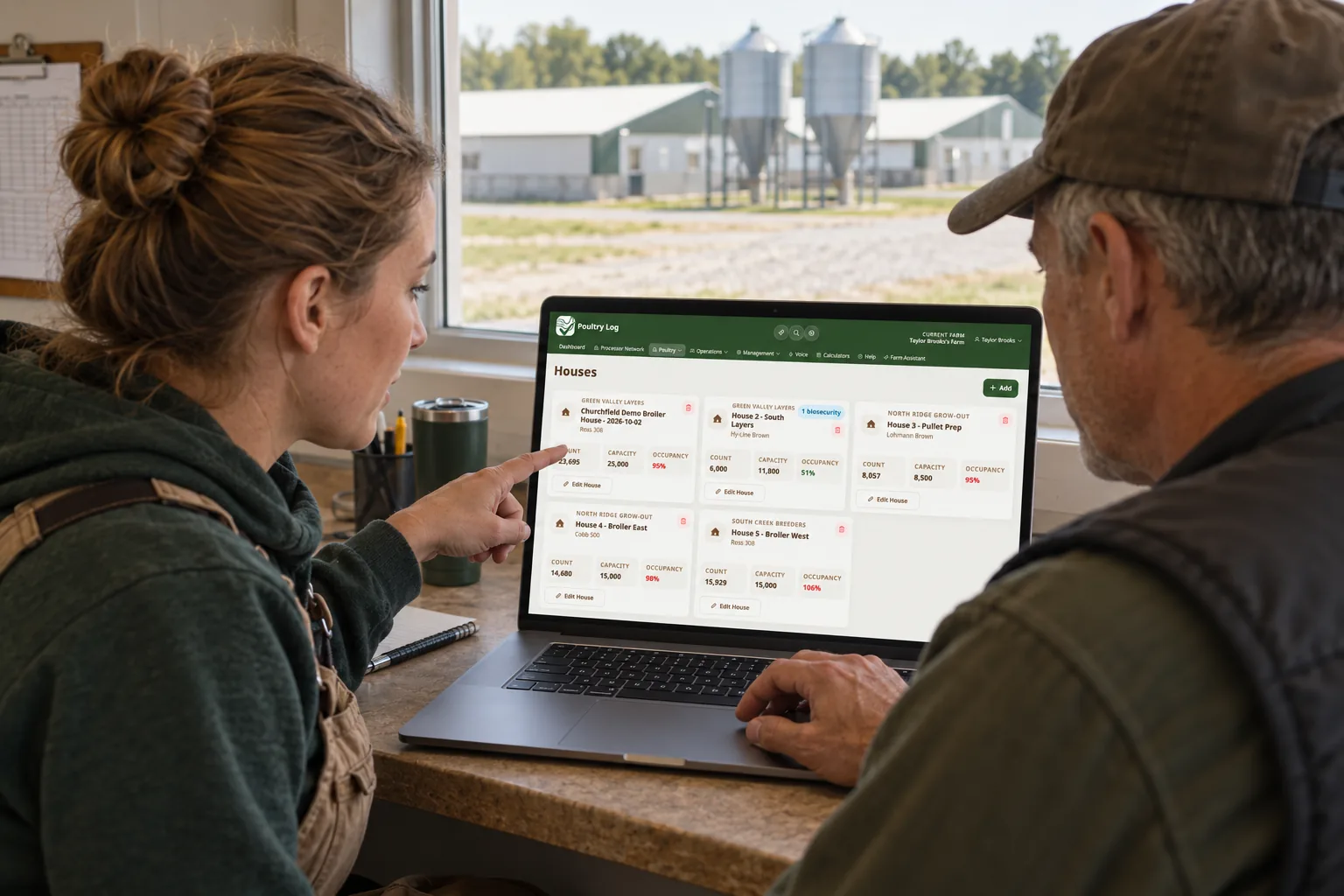
The best house managers track environmental data — temperature, humidity, ammonia levels, ventilation settings, and litter condition — daily and compare trends across flocks. A structured record keeping system that captures house conditions alongside bird performance data (mortality, water consumption, feed intake) makes it possible to identify which environmental conditions consistently produce the best flock outcomes.
Growers who log house conditions and review trends between flocks can spot emerging problems — a gradual litter moisture increase, a creeping ammonia trend, a ventilation controller drift — before they affect bird performance. That proactive approach is what separates top performers from average ones.
Measure the House by Margin, Not Settings Alone
Environmental settings matter because they change costs and saleable output. Track electricity, fuel, litter treatment, repair expense, mortality, average weight, and feed conversion by house and flock. Compare houses under similar weather and bird age so an efficient fan program is not mistaken for simple seasonal luck. If one house uses more fuel but produces heavier birds with lower mortality, calculate the net margin before cutting heat. If another consumes more power without improving pounds or livability, inspect fan belts, inlets, insulation, sensors, and controller calibration. House management earns its place when the records show which adjustment saves money or produces more paid weight.