
Every number a broiler grower is paid on arrives from the integrator's systems: the settlement sheet, the performance report, the tournament ranking. Those sheets are usually accurate — but they are not yours. You cannot query them, trend them, or hold them next to last year's. An independent record is your own timestamped history of the same flock: mortality, water, feed, weights, expenses, and settlement income, kept in systems you control. This page explains what an independent record contains, why it is the grower's only leverage in a disagreement, and how the record set turns into the comparison that settles questions.
What an Independent Record Contains
| Record | What It Captures | What It Answers |
|---|---|---|
| Exit counts by house and date | How many birds left each house, and when | "Your delivered count is 40 birds short of my exit records — here are both, by house." |
| Weekly sample weights | Individual weights, average, CV% by house and date | "Your average weight is 0.2 lb under my last pre-catch sample — here is the series." |
| Mortality logs with timestamps | Every loss by house, date, time, suspected cause | "Mortality was 3.2%, dated daily — not 2.8% rounded to the week." |
| Feed delivery tickets | Weight, phase, bin, date for every delivery | "FCR consumed, not delivered: here are the tickets and the bin-remaining count at catch." |
| Expenses tied to the flock | Feed, fuel, bedding, repairs, labor — attributed per flock | "What this flock cost — so the disputed pounds have a price." |
| Settlement income recorded | What the integrator paid, against the same flock | "Margin between your sheet and my costs — and which line of yours I am questioning." |
Why One Source of Data Is a Disadvantage
Growers who depend solely on integrator-provided sheets cannot query them, trend them, or hold them against their own history. When a number surprises at settlement, there is no quick way to check it — the conversation starts from memory against a document, and memory loses. The growers who sleep best keep their own books: not because they distrust their integrator, but because verification requires two measurements, and they control exactly one of them. The same discipline pays on the competitive side: in a tournament, the grower whose records support their performance position argues from documents, not from feeling.
From Record to Comparison
An independent record earns its keep at three moments:
- Settlement day: the comparison method runs your records against the sheet line by line — population chain first, then weight, then FCR — quantifying each variance in dollars before escalating it with dated evidence attached.
- Problem weeks: the water early-warning habit and the growth bands both depend on records that exist daily — the independent record is what turns a deviation into a decision while the flock can still recover.
- Across seasons: the trend across flocks — what margins actually averaged, which cost lines moved — is the picture no single settlement sheet can draw, and the basis for every contract and equipment conversation that follows.
Building the Independent Record in Poultry Log™
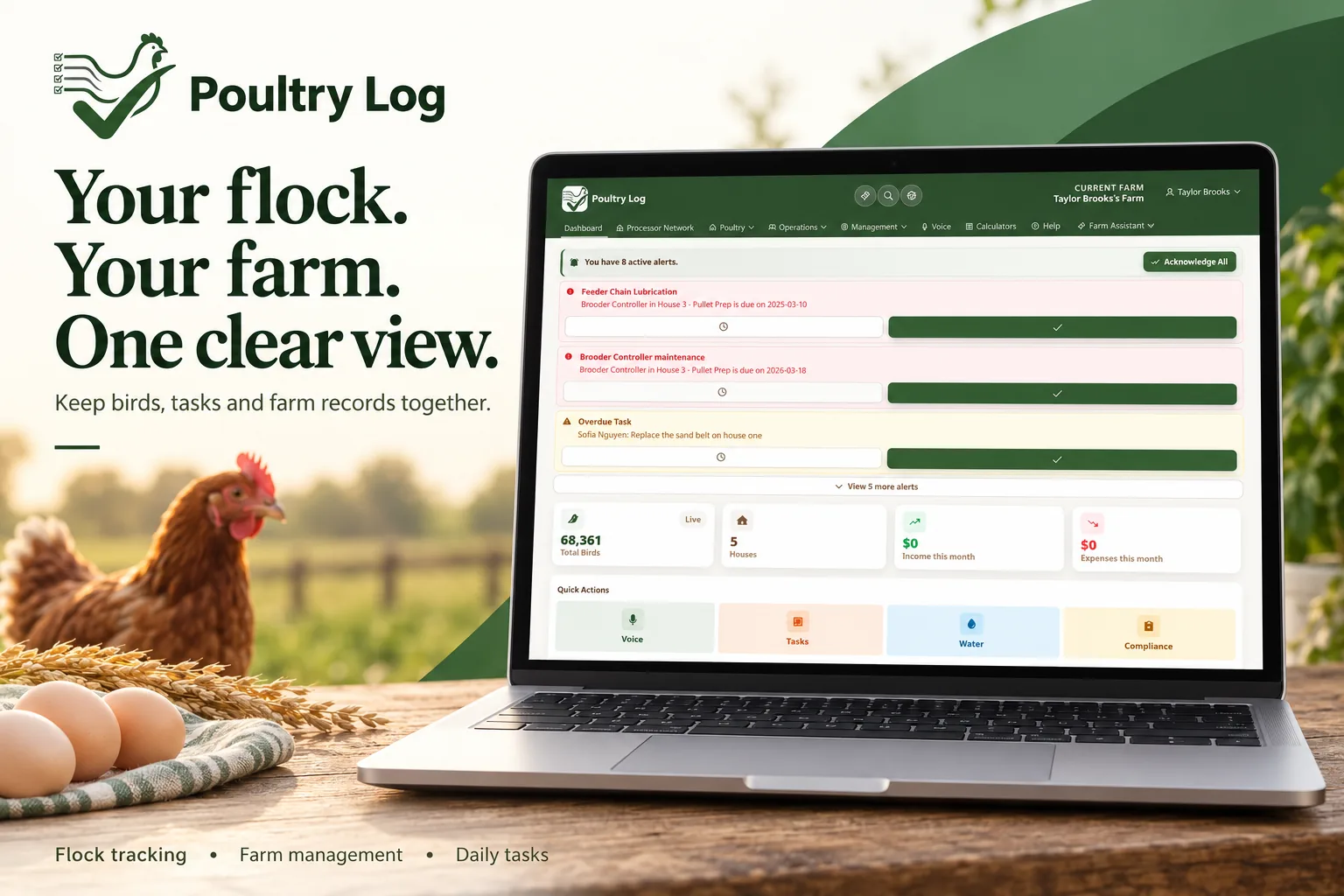
Poultry Log™ exists to keep the grower's side of this equation: exit counts, weekly sample weights with CV%, mortality with timestamps, feed deliveries, expenses tied to flocks, and settlement income against the same flocks — all timestamped, house-attributed, and exportable. The settlement calculator runs the comparison; the break-even price supplies the floor beneath which the flock lost money regardless of what the comparison finds; and the profitability dashboard carries the multi-season trend. The record set is also the compliance layer — see the integrator records requirements for what programs expect and the audit-ready guide for how it walks into an audit.
- Settlement comparison method — the line-by-line reconciliation.
- Broiler settlement calculator — running your numbers against the sheet.
- Poultry management software buyer's guide — evaluating any tool that will hold your independent record.
- 2026-10-05: Comprehensive rewrite. Record-contents table, one-source disadvantage framing, record-to-comparison path, and tool linkage — replacing the earlier 380-word version.
- Earlier version: brief prose introduction to independent records.