
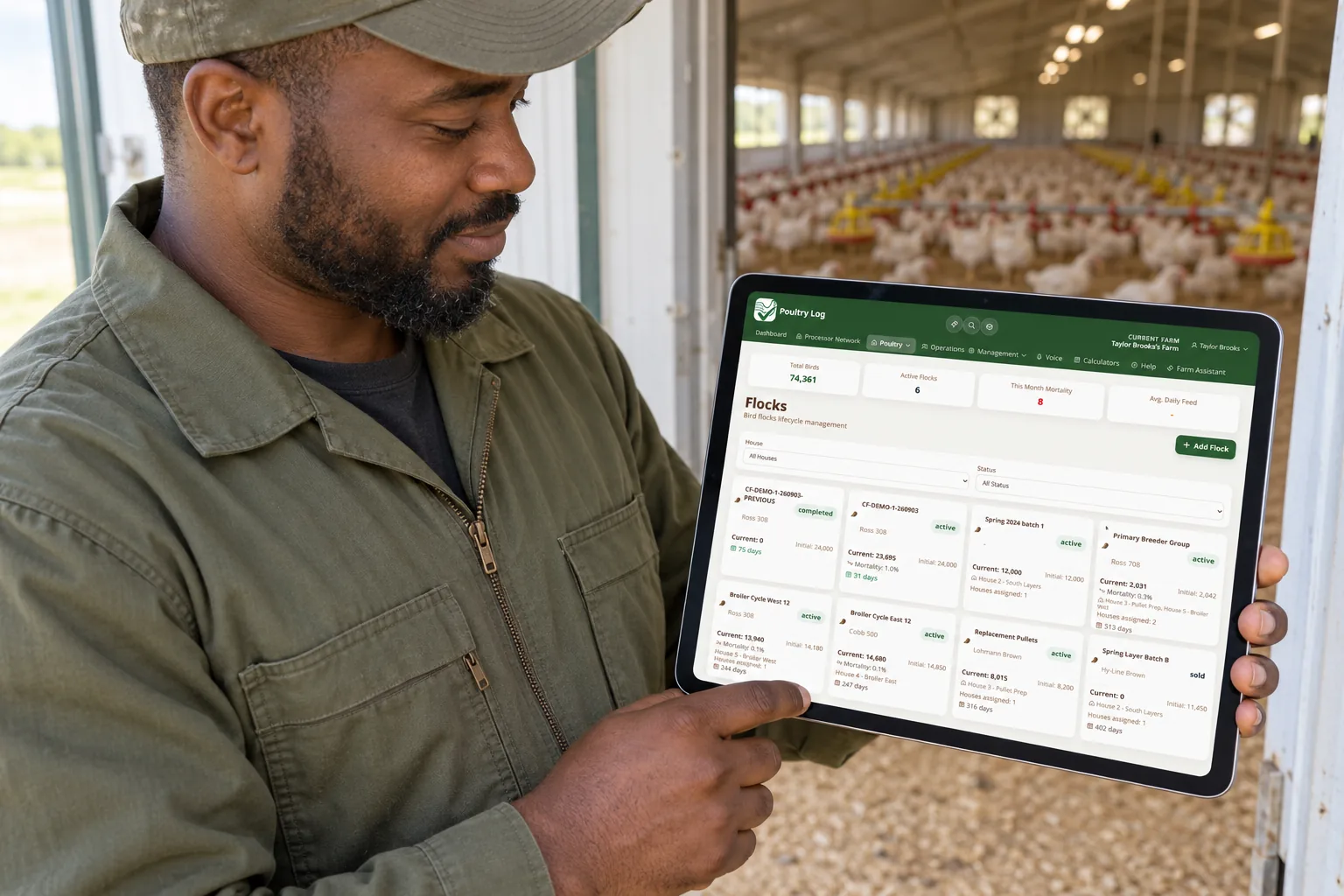
Connecting PoultryLog to ChatGPT is the easy part. The part that decides whether it saves you time or becomes a novelty is knowing what to ask — because the difference between "how are my birds doing?" and a question with a house, a flock, and a window of time attached is the difference between a vague summary and a decision. This is the prompt playbook for broiler growers, organized by the moments when the answer actually matters: the morning check, the anomaly hunt, the integrator call, and the settlement conversation.
The Morning Check: Three Questions Before Coffee Is Cold
These confirm the connection is reading your account and surface anything that needs a person on site today:
| Ask | What It Returns | The Decision It Supports |
|---|---|---|
| "What farms do I have?" | Your authorized farms, from the linked account. | Confirms the connection is correct before you trust anything else. |
| "What flocks are active?" | Active and recent flocks with assigned houses. | Which houses are in production right now — the frame for every question below. |
| "Show me my active alerts." | Current house alerts across permitted farms. | What needs attention before the day's other work starts. |
If the alert list is empty, that is information too — but confirm the data is current before treating silence as good news. An alert-free house with stale logs is a different problem than an alert-free house with fresh ones.
The Flock Performance Questions
These draw on flock metrics — weights, mortality, feed, and water history — and are the ones that replace the ten-minute spreadsheet session:
- "How is my current flock doing?" — Flock-level performance against targets. Start here when you have one flock in play and need the headline.
- "Compare my houses in this flock." — House-by-house comparison within the selected flock. This is the question that finds the house dragging the average before the integrator's report does.
- "Which house looks unusual today?" — Surfaces the outlier. Follow any answer with "what changed in that house in the last 24 hours?" to get the window around it.
- "What changed in House 3 in the last 24 hours?" — Time-boxed change review for one house. Confirm the exact period and units in the answer before acting on it.
House comparison is where the money lives. A house running 5% behind its flock-mates for three weeks is not a rounding error — at $0.50/lb feed on a 30,000-bird house, the feed-conversion gap between the best and worst house in a flock is often worth more than the whole tournament bonus. Ask the comparison question weekly, not monthly.
The Anomaly Questions: Water, Mortality, and the Early-Warning Chain
Water moves first, feed second, weight third. These prompts follow that chain:
- "Did any house have a water drop this week?" — Checks water history against the expected curve for bird age and temperature. A 10%+ drop is the trigger to walk the house — see the water consumption chart for the thresholds.
- "Show me mortality by house for the last 7 days." — Mortality pattern by house and date, from your logged counts. Patterns matter more than totals: a house with a rising daily trend is a different problem from one with a single spike.
- "What was water intake in House 2 versus House 5 last week?" — Direct house-to-house water comparison. Pair it with the feed comparison — water down with feed down points somewhere different than water down alone.
Every one of these answers is only as good as the logs behind it. The prompts surface the pattern; the growth chart decision tree and the feed intake protocol are what you work through once the pattern is visible.
The Integrator and Settlement Questions
For growers in a processor network, the connection reads the compliance and performance records shared under your consent — so these questions answer from your side of the paperwork:
- "Which compliance checklists are still open for my farms?" — Outstanding evidence before an audit or review, instead of discovered during one.
- "What did I submit to the processor this month?" — Your submitted records, as the processor sees them — so the settlement conversation starts from the same facts on both sides.
- "How do my recorded costs compare across my last three flocks?" — Expense history by flock, from your own logs. This is the number that makes the settlement comparison honest — and the one behind the settlement calculator's independent-records argument.
Rules for Questions You Can Act On
- Name the house and the window. "Compare House 1 and House 4 last week" returns something you can act on; "how are my birds?" returns something you nod at.
- Confirm units and timestamps. Gallons versus liters, grams versus pounds, partial-day caveats — the answer includes them, but reading them aloud to yourself before acting costs two seconds and prevents expensive mistakes.
- Treat missing data as a finding, not a failure. "No water logs for that house since Tuesday" is often the most important sentence in the answer — it means nobody read the meter, and every per-bird number since then is guesswork.
- Log what you learn back into the record. If a prompt reveals a gap — a missing weigh-in, an unlogged mortality count — fix the log, not just the symptom. The next answer depends on it.
- Disconnect when you are done. The connection is yours to end from PoultryLog Settings at any time, and it immediately denies further requests.
The pattern behind all five rules is the same one PoultryLog runs on: the record is what turns a guess into a decision. ChatGPT does not change that — it makes the record faster to read, in the place you already think out loud.
- Can: farms, flocks, houses, flock and house performance, water and mortality history, active alerts, metric history, compliance records, and consented processor records — from your authorized account.
- Cannot: anything outside your authorization, another grower's data, or measurements that were never logged. Missing data stays unavailable rather than invented.
- 2026-10-05: Initial version. Prompt playbook by moment — morning check, flock performance, anomalies, integrator/settlement — with action rules.