
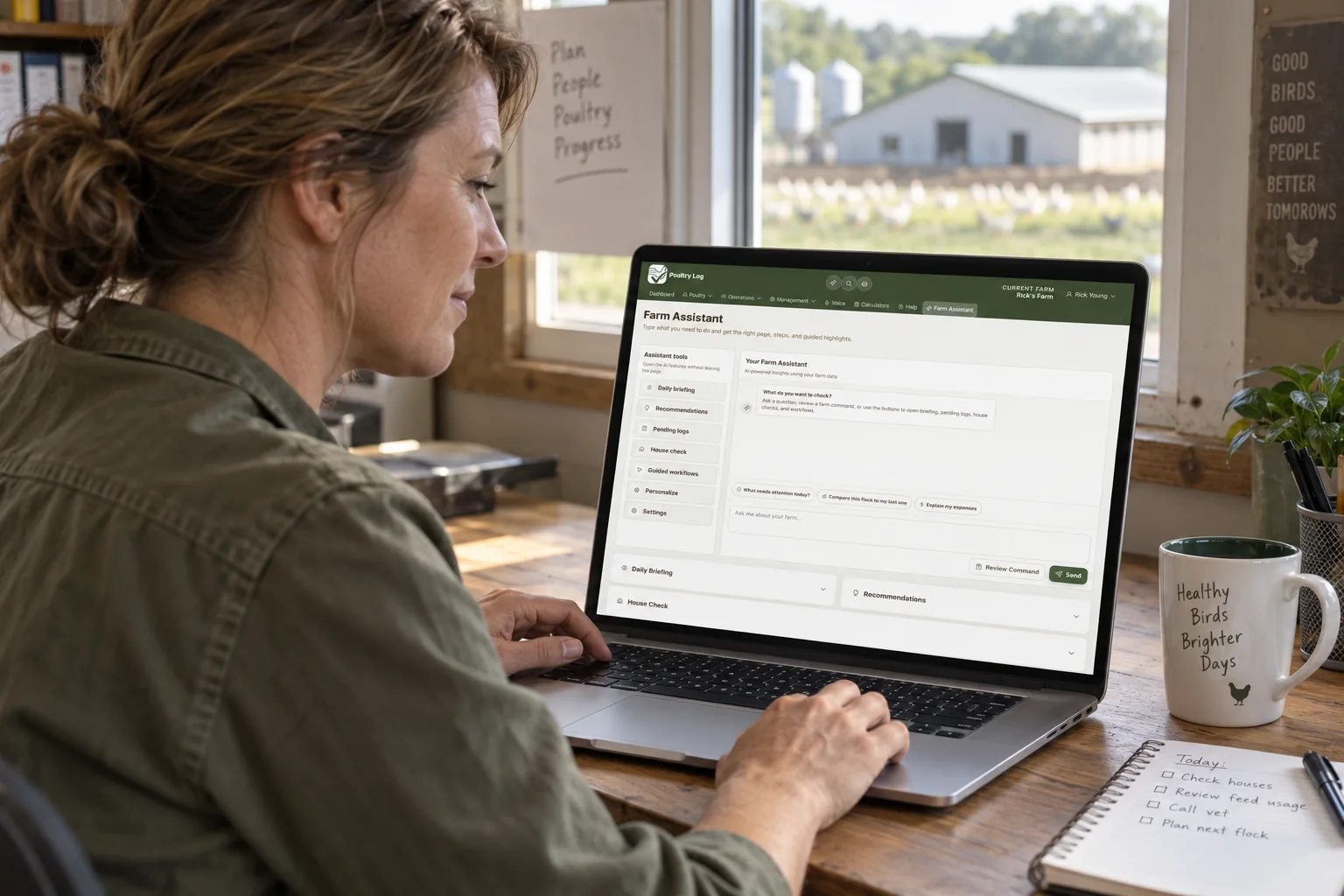
Settlement disputes are won with records, not memory. When an integrator's sheet disagrees with what you remember, the grower with dated, house-level records has something the other side does not: a second measurement of the same flock. An app built for settlement disputes keeps the independent record set — exit counts, sample weights, mortality logs, feed tickets — that turns a disagreement into a documented comparison instead of an argument. This page covers what dispute-ready records demand, what to verify in any app, and where PoultryLog™'s record set stands against those demands.
What Do Settlement Disputes Actually Turn On?
| Disputed Line | The Record That Answers It | What to Verify in Any App |
|---|---|---|
| Delivered bird count | Exit counts by house and date from your own walk, not the integrator's catch tally | Record exit counts per house with dates; confirm they export |
| Average live weight | Weekly sample weights with dates — your independent measurement of the same birds | Store individual weights per house; confirm CV% and averages compute |
| Mortality attributed to the flock | Daily mortality logs with timestamps — the population chain placed → alive → delivered | Log mortality with time and house; retrieve the full curve |
| Feed conversion position | Feed delivery tickets plus bin-remaining counts at catch — consumed feed, not delivered feed | Record deliveries with weight and phase; check they appear in history |
| The dollar impact of each variance | Your own cost records — what the flock cost, so the disputed pounds have a price | Expenses tied to the flock; cost per pound available |
What to Verify Before You Trust the Record
- Run the retrieval drill: ask the app for one flock's full record — counts, weights, mortality, feed — timed. Disputes have deadlines; retrieval that takes hours is retrieval you will not do.
- Check date integrity: every entry must carry the date it was made, not the date it was edited. A record whose timestamps can shift is weak evidence.
- Confirm the population chain is reconstructable: placed, alive at catch, delivered — from your logs alone. That chain localizes every other variance.
- Ask about export under pressure: disputes move fast. Standard-format export, on demand, including after you cancel — get it in writing before you need it.
Where PoultryLog™ Fits
PoultryLog™ keeps the dispute spine as structured records: exit counts by house and date, weekly individual sample weights with CV%, mortality with timestamps, feed deliveries with weight and phase, and expenses tied to the flock — so the population chain, the weight record, and the FCR inputs exist in one place before the settlement arrives. The settlement calculator runs your numbers against the sheet's claims; the break-even price supplies the line below which the flock lost money regardless of what the comparison finds. It is strongest for contract broiler growers; for honest limits, see the buyer's guide.
Where the Money Shows Up
Dispute-ready records pay at three moments. Mid-flock: the records exist because daily logging built them — disputes cannot be prepared retroactively. At settlement: each variance quantified in dollars decides which are worth escalating; a 0.02 FCR difference on 30,000 birds to 6.4 lb is roughly $1,900 at $0.50/lb feed, and a 0.1 lb average-weight difference is 2,910 lb of live weight. Across seasons: growers who document variances get cleaner sheets over time, because the integrator's side knows your records exist. The tournament guide covers the same discipline in competitive terms.
- Poultry management software buyer's guide — parent evaluation framework.
- Settlement comparison method — the line-by-line reconciliation.
- Independent records — why your copy of the numbers matters.
- 2026-10-05: Comprehensive rewrite. Dispute-line table, verification drill, and honest positioning under the buyer's guide — replacing the earlier self-ranking version.
- Earlier version: "best app" ranking with unverified competitor claims.