
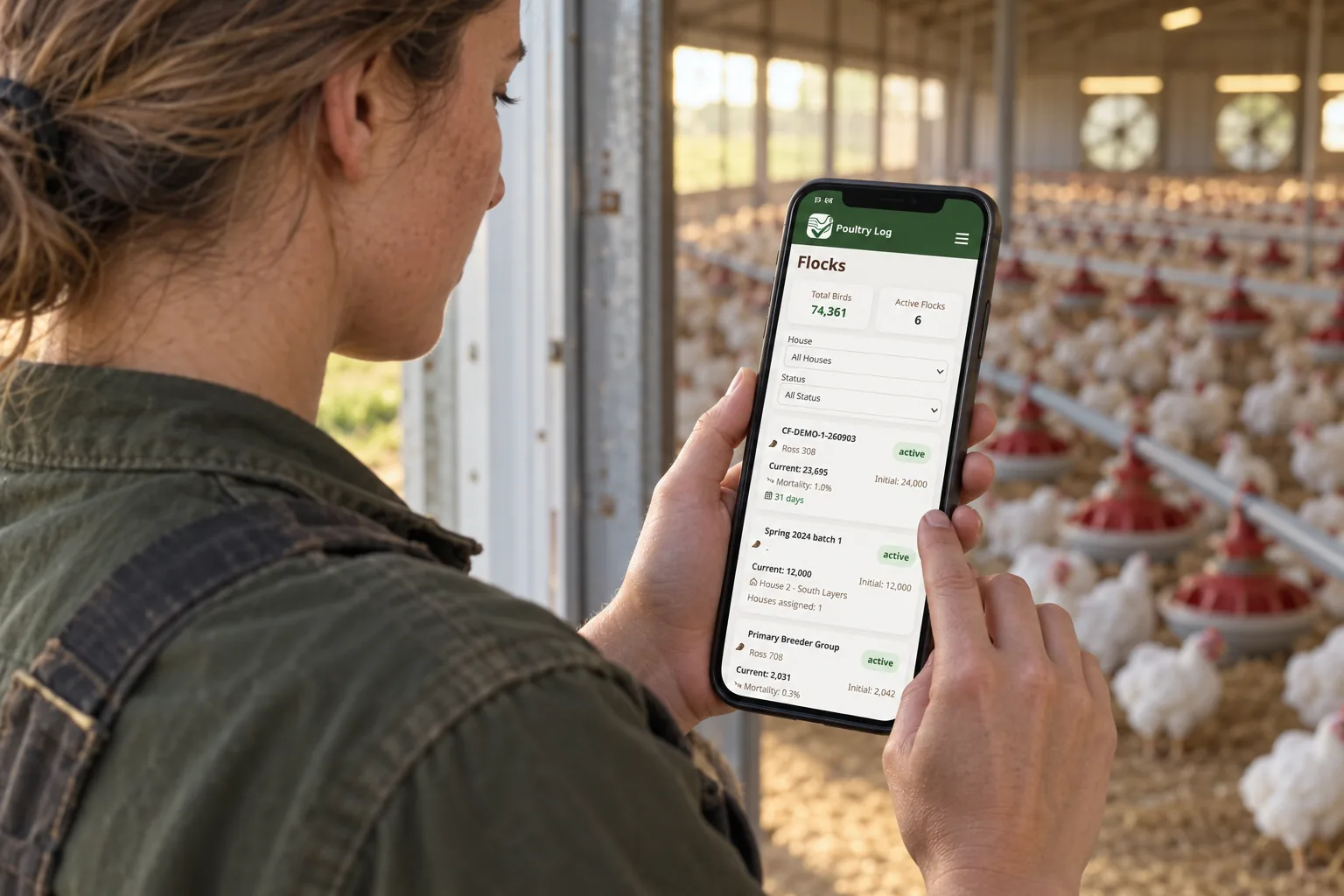
Contract broilers is a different business from farming for yourself: your pay is a rank, your records answer to an integrator's program, and the settlement sheet arrives from systems you do not control. Software for contract growers earns its place when it keeps the independent record set that checks the integrator's computation — house-level history, dated logs, settlement comparison — without fighting the program's own compliance requirements. This page covers what contract growing demands from software and how to verify any tool against those demands.
What Does Contract Growing Demand from Software?
| Demand | Why Contract Specifically | What to Verify in Any App |
|---|---|---|
| Independent house and flock history | The integrator's sheet is their measurement; yours is the only independent one — tournament and dispute conversations run on whose records hold up | Record a full flock's daily logs; confirm retrieval by house and date |
| Settlement comparison | Tournament pay computes FCR and performance against the complex — you need your own numbers to check theirs | Record settlement income; confirm the app supports comparison against your records |
| Compliance record exports | Integrator programs specify what must be recorded — mortality, treatments with withdrawal dates, biosecurity, equipment — and audit for it | Request a one-month compliance export in the demo; check the record set matches your program's requirements |
| Multi-house daily logging | Contract growers run houses at scale — logging must survive a 4-house morning walk, one-handed, offline if needed | Time entries across two houses in the demo, with the device offline |
| Cost visibility under contract terms | Feed often flows through the integrator — knowing what the flock actually consumed and cost is how you evaluate the contract, not just the birds | Record feed deliveries and expenses against the flock; check cost per bird surfaces |
What to Verify Before You Trust the Tool
- Run the morning-walk drill: log mortality, water, and a note across two houses on mobile, offline. Contract scale makes friction fatal — if it takes longer than the walk, the record dies.
- Check the compliance export against your program: your integrator's requirements are the standard, not a generic checklist. Pull the record set your program actually asks for and compare.
- Confirm the settlement path: record what was paid, compare it to your records — per the comparison method. If the app cannot hold your side of that comparison, it is not built for contract work.
- Ask about data ownership under the contract: your records should be yours regardless of the contract relationship. Export terms matter most when the relationship ends.
Where PoultryLog™ Fits
PoultryLog™ is built for the contract row: multi-house daily logs with time-of-day stamps and offline capture, weight against breeder curves, expenses and feed deliveries tied to flocks, settlement income recorded against the same flocks, and compliance checklists structured to your program's requirements — per the integrator records standard. Its strongest fit is US integrator contract broilers; its honest limits: not a layer system, not a mixed-species manager. For other segments and the full framework, see the buyer's guide.
Where the Money Shows Up
Contract software pays where contract money concentrates: the tournament (independent records check the computation — see winning the tournament), settlement disputes (dated records are the evidence — see the comparison method), audit weeks (exports instead of reconstructions — see audit-ready records), and contract evaluation itself (knowing what the flock actually cost before you renegotiate). The settlement calculator and the break-even price turn the record set into the numbers those conversations run on.
- Poultry management software buyer's guide — parent evaluation framework.
- Integrator records requirements — the record set programs specify.
- Broiler contract farming — how the contract relationship works.
- 2026-10-05: Comprehensive rewrite. Segment demand table, verification drill, and honest positioning under the buyer's guide — replacing the earlier self-ranking version.
- Earlier version: "best app" ranking with unverified competitor claims.