

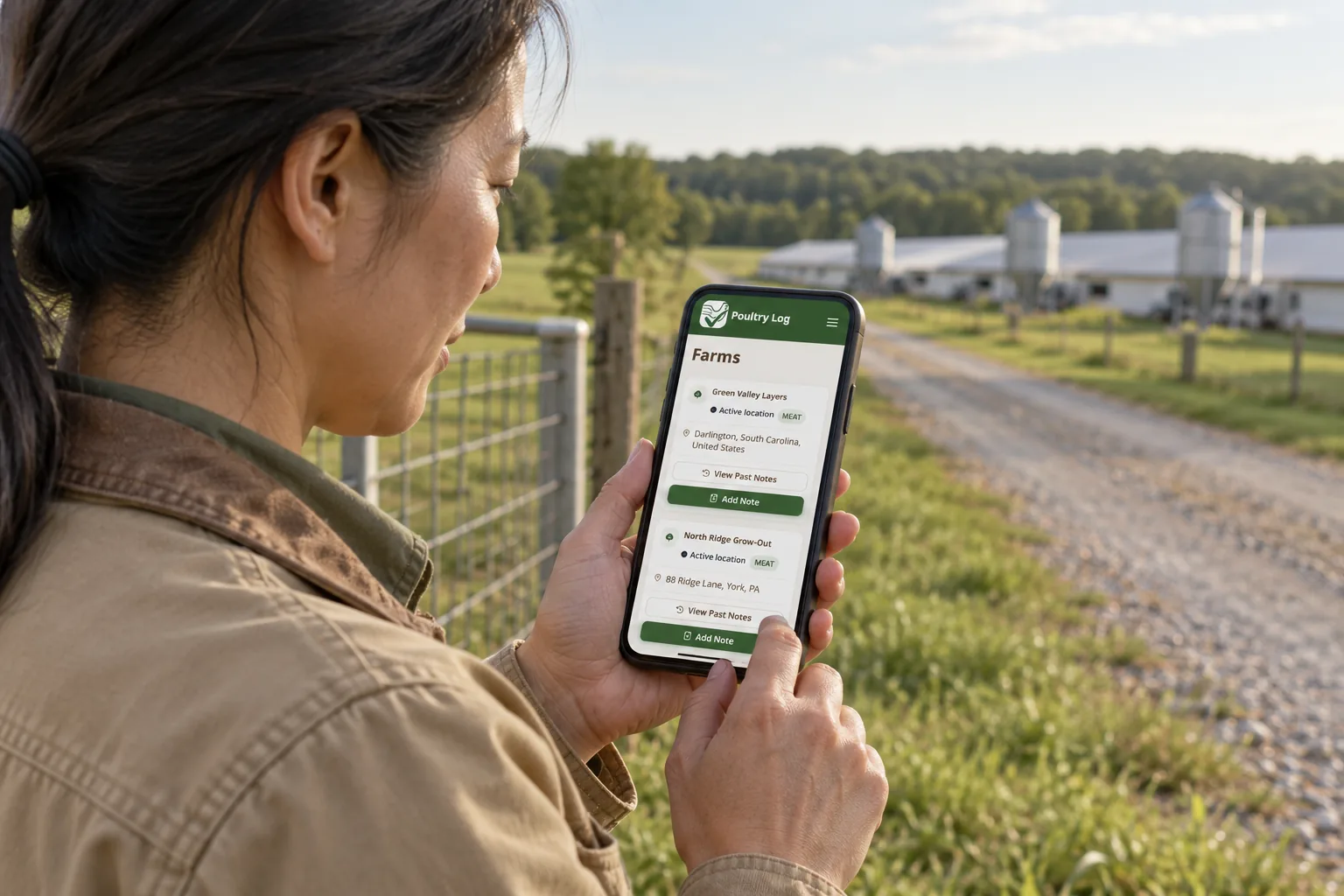
Almost every US state requires some form of poultry premises registration, and almost none of them agree on the details. Some states register every location where poultry are kept regardless of size; others exempt small or temporary flocks; others register through the integrator rather than the grower. For an operation with more than one site, or a grower who has moved states, premises registration is the first compliance question that has to be answered correctly, because most other state programs key back to it. Poultry Log's state catalogs record each state's registration duty with its agency, authority, and official source link.
What Premises Registration Actually Covers
A premises registration ties a physical location to the person responsible for the poultry kept there, plus the basic facts about the flock. In the Poultry Log catalog, the required fields across states are consistent in shape: owner or caretaker identity and contact information, the mailing and bird-location addresses, poultry types and counts, flock purpose and bird sources, and the mortality method where the state asks for it. Some registrations also ask for the integrator relationship explicitly, which matters for contract growers whose registration may already sit with their company.
How the States Differ, as the Catalog Records It
- Delaware - every location where live poultry is kept must be registered, and the catalog records that no bird-count or commercial-use exemption appears in 3 DE Admin. Code 901 section 4.0.
- Maryland - registration is required for each location under Md. Code, Agriculture Article, Section 3-804, with a narrow exemption for five or fewer birds kept less than 120 days in a 12-month period, and a note that contract growers may already be registered through their company.
- Other state catalogs - registration duties appear across the fifty-state catalog with state-specific applicability rules, exemptions, and submission destinations, each carrying its official source link and form version.
Why the Registration Question Comes First
State programs treat the registered premises as the anchor for everything else: disease reporting runs to the State Veterinarian for the registered location, import health documents are addressed to it, environmental permits are issued to it, and inspection histories attach to it. A farm that gets the registration wrong, or misses that its grower is already registered through an integrator, spends the rest of the compliance year correcting the foundation. The catalog's applicability rules exist to answer exactly that: does this location, with these birds, need to register, and who submits it?
What Registration Does Not Claim
A premises registration records where poultry are kept and who is responsible. It does not certify that the operation meets any production, environmental, or food safety standard, and completing a Poultry Log checklist does not certify legal compliance. The registration requirement itself comes from the state; the record's job is to make the filing complete and the confirmation findable.
Where Poultry Log Fits
Poultry Log's state catalogs carry each registration duty with its official source link and form template, inside the same workspace as the rest of the farm's records. State deep-dives are covered in the Delaware guide, the Maryland guide, the Georgia guide, and the Arkansas guide, with the catalog structure in the US integrator compliance records guide. Confirm current requirements with your state department of agriculture. Start free at poultrylog.com.
Frequently Asked Questions
Do all states require poultry premises registration?
Most US states require some form of registration for locations where poultry are kept, but the details differ: some exempt small or temporary flocks, some register through the integrator, and some cover every location regardless of size. Poultry Log's state catalogs record each state's duty with its agency, authority, and official source link.
Are contract growers already registered through their integrator?
It depends on the state. The Maryland catalog records that contract growers and certain registered layer flocks may already be registered through their company or an MDA program, which is worth confirming before filing a duplicate. The catalog's applicability rules record each state's position on the question.
What information does a poultry premises registration require?
Across states, the shape is consistent: owner or caretaker identity and contact information, mailing and bird-location addresses, poultry types and counts, flock purpose and bird sources, and mortality method where the state asks for it, with some states also recording the integrator relationship.