

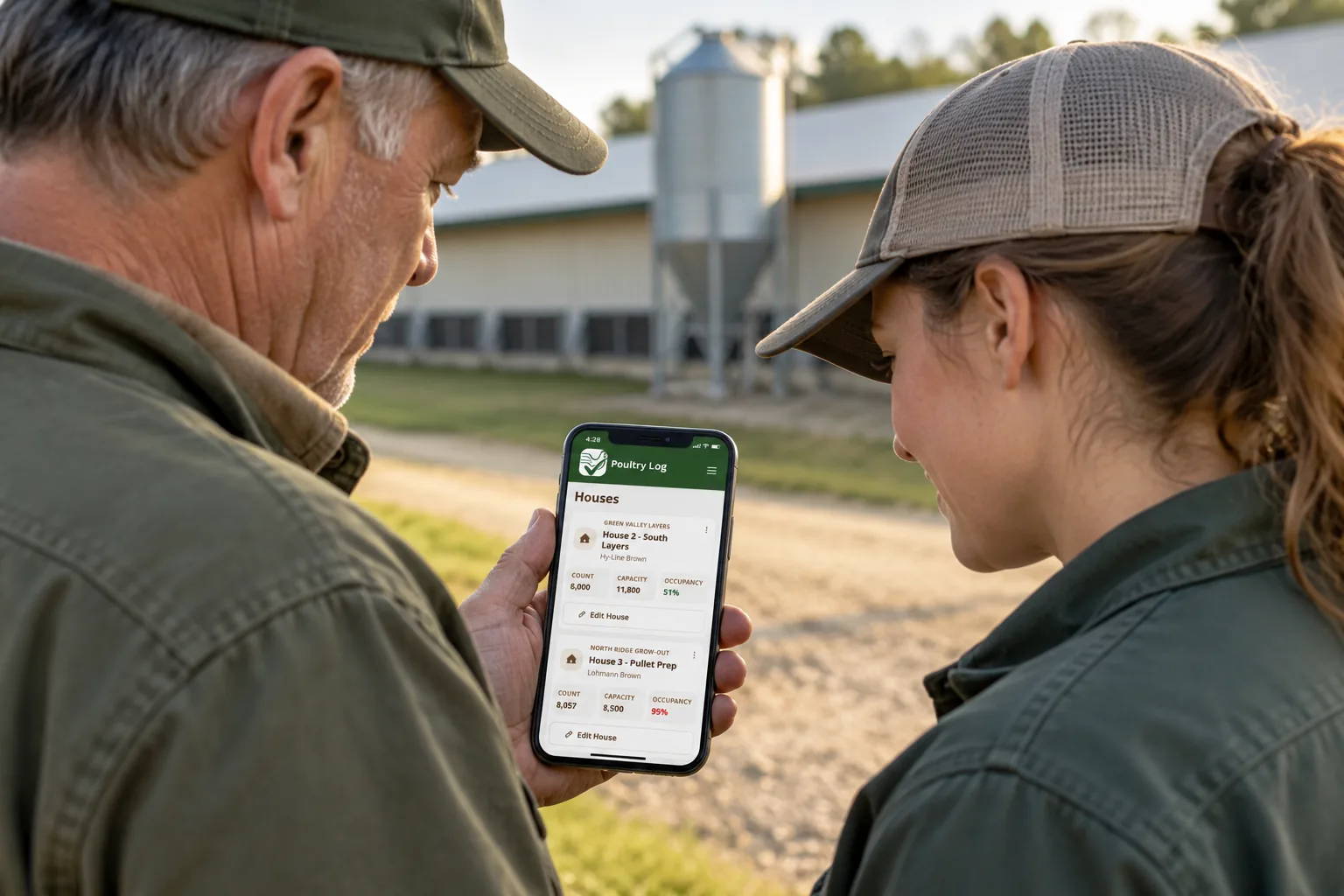
Delaware's poultry compliance program is one of the most integrated in the United States: the state registers every location where live poultry is kept, requires commercial farms to hold a mortality plan signed by their integrator, and runs a nutrient management program with plan thresholds, certification duties, and a six-year record retention rule. For a Delmarva operation or an integrator oversight team, Poultry Log's Delaware catalog records each requirement with its agency, authority, cadence, retention, and official source link.
Premises Registration: Every Location Counts
Under 3 DE Admin. Code 901 sections 3.0 and 4.0, every Delaware location where live poultry is kept must be registered with the Department of Agriculture's Poultry and Animal Health Section. The catalog records that no bird-count or commercial-use exemption appears in section 4.0: the rule covers commercial and non-commercial producers alike. Registration asks for owner and contact information, the poultry location, the integrator, species and counts, egg sales and purpose, mortality method, and a signature, with updates when contact or premises information changes.
The Integrator-Signed Mortality Plan
Delaware's commercial mortality plan requirement is unusual and worth understanding precisely. Under 3 DE Admin. Code 901 section 8.1.2, each commercial poultry farm must submit a separate normal day-to-day mortality disposal plan that is signed, approved, and verified by its integrated poultry company. The catalog records the required fields as farm and integrator, normal mortality method and capacity, grower and integrator approvals, and effective date, with superseded approvals preserved with the farm compliance record. For growers in a processor network, this is the requirement where the integrator relationship becomes a documented compliance artifact rather than an informal understanding.
Movement, Health, and Disease Duties
- Out-of-state sales - when poultry leave Delaware and ownership changes out of state, sale records and approved return-cleaning receipts are kept at least one year (section 5.0).
- Entry health records - poultry and hatching eggs entering Delaware need avian-influenza and Pullorum-Typhoid evidence plus a health certificate or NPIP VS Form 9-3, with advance State Veterinarian approval for quarantined-area movements (section 9.0).
- Dealer licensing - businesses buying, selling, or transporting live poultry need an annual livestock dealer license through June 30, with traceable transaction records (3 Del. C. Chapter 76).
- Disease reporting - a suspected disease capable of causing a public-health emergency must be reported to the Department within 24 hours, under 16 Del. C. section 121(9)(e).
Nutrient Management and CAFO Coverage
The Delaware Nutrient Management Commission requires a nutrient or animal waste management plan for an AFO with more than eight animal units, or where nutrients are applied to more than ten acres, under 3 Del. C. section 2247 and 3 DE Admin. Code 1201. Certification and activity records carry a six-year retention rule, and every plan holder files the Commission annual report by March 1. On the environmental side, large poultry CAFOs and qualifying discharging operations obtain NPDES coverage through 7 DE Admin. Code 7201, with the NOI and management plans kept onsite for six years.
Where Poultry Log Fits
Poultry Log's Delaware catalog carries every requirement above with its official source link, applicability rules, and form templates, inside the workspace growers use for daily records. The integrator-signed plan connects directly to the processor network described in the processor network explained guide, the nutrient layer in the nutrient management plan records guide, and the federal layer in the US integrator compliance records guide. Confirm current requirements with the Delaware Department of Agriculture and the Nutrient Management Commission; completing a checklist does not certify legal compliance. Start free at poultrylog.com.
Frequently Asked Questions
Do all Delaware poultry locations need to be registered?
Yes. Under 3 DE Admin. Code 901 sections 3.0 and 4.0, every location where live poultry is kept must be registered with the Delaware Department of Agriculture, and the catalog records that no bird-count or commercial-use exemption appears in section 4.0.
Why does a Delaware poultry mortality plan need an integrator signature?
Under 3 DE Admin. Code 901 section 8.1.2, each commercial poultry farm's normal day-to-day mortality disposal plan must be signed, approved, and verified by its integrated poultry company, with approvals kept on file and superseded versions preserved with the farm compliance record.
What nutrient management thresholds apply in Delaware?
An AFO with more than eight animal units, or nutrients applied to more than ten acres, must develop and implement a nutrient management plan under 3 Del. C. section 2247 and 3 DE Admin. Code 1201, with certification and activity records retained six years and the Commission annual report filed by March 1.