
For a broiler grower in the European Union, one piece of law sets the floor for almost everything an inspector will ask about: Council Directive 2007/43/EC on the protection of chickens kept for meat production. It fixes maximum stocking density, sets requirements for lighting, litter, feeding, and ventilation, requires a register of flock events, and obliges member states to inspect. It introduced welfare indicators into EU animal welfare legislation for the first time. This page explains what the directive requires at farm level, what the records must contain, and how the daily log you keep is what makes an inspection routine instead of a crisis.
What Stocking Density Does the Directive Allow?
The directive caps maximum stocking density — the total live weight of birds per square metre of usable floor area — and ties additional obligations to higher densities:
| Stocking Density | Rule Set | What It Adds |
|---|---|---|
| Up to 30 kg/m² | Simplified provisions | Core welfare duties apply with reduced environmental detail |
| 30–33 kg/m² | Standard requirements (Annex I) | Lighting, litter, feeding, ventilation, monitoring, and documentation duties apply in full |
| Up to 39 kg/m² | Annex I plus Annex II conditions | Additional environmental provisions — including air-quality monitoring — must be met and documented to hold the higher density |
Sources: Council Directive 2007/43/EC (28 June 2007), Articles 3–4 and Annexes I–II; European Commission broiler welfare summary. The 33 kg/m² ceiling and the conditional route to 39 kg/m² are the directive's headline limits.
- Council Directive 2007/43/EC of 28 June 2007 laying down minimum rules for the protection of chickens kept for meat production. EUR-Lex (CELEX:32007L0043)
- European Commission — Animal welfare, broilers. food.ec.europa.eu
- EUR-Lex summary — protection of chickens kept for meat production. EUR-Lex LEGISSUM
What Daily Conditions Must the House Meet?
Annex I of the directive covers the conditions an inspector checks on arrival:
- Lighting: a regular daily rest period with the lights off — at least four hours in addition to the natural dark period — with adequate light intensity for birds to find feed, water, and each other during the lit period.
- Litter: sufficient dry, friable litter material covering the floor, managed to stay in a condition that does not harm the birds — wet or caked litter is the most common failure an inspector sees, and the one most tied to footpad and hock lesions.
- Feeding and watering: continuous access to appropriate feed and to drinking water adapted to the birds' needs, with equipment checked daily for function.
- Ventilation: air exchange sufficient to remove heat, moisture, and ammonia — thermal comfort across the whole floor area, not just at the controller sensor.
- Health and handling: daily observation of the flock, removal of dead birds, and care of sick or injured birds per the directive's provisions.
The practical pattern: every one of these conditions produces a record if you keep one. Litter condition noted on the daily walk, ventilation and temperature readings, feed and water checks, mortality with dates — the same daily log PoultryLog is built around is the evidence layer the directive assumes exists.
What Must the Register Contain?
Article 10 of the directive requires a register — on paper or in standard computerised form — covering, as a minimum:
| Register Entry | Detail Required |
|---|---|
| Day-old chicks | Species or hybrid, number of birds, date of arrival, number of animals |
| Killing / slaughter | Date, number of birds, reason where applicable |
| Dead birds | Number of dead animals and the date of removal of litter and droppings |
| Inspections | Date of official inspections, names/signatures of inspectors where required |
Member states can require more, and national authorities often publish their own register templates — use the form your authority expects rather than inventing one. The register must be kept available for inspection for the period your national rules specify. A digital log satisfies the "standard computerised form" route when it captures the same fields with dates; a photo of a notebook page does not.
How Inspections and Welfare Indicators Work
Member states are required to carry out inspections of broiler holdings — including at least one full inspection per grower per year, supplemented by spot checks — and the directive's welfare-indicator provisions mean inspectors look beyond survival to measurable condition. Commonly monitored indicators include footpad lesions, hock burn, general health and lameness, and mortality levels. EFSA — the European Food Safety Authority — has published scientific opinions on broiler welfare that inform how these indicators are defined and monitored across the EU, which is why the same indicator names appear in processor specifications and national inspection guidance.
For a grower, the implication is simple: the indicator an inspector scores is one your own routine observation already sees daily. A flock whose footpads are deteriorating over week three shows it in the litter-condition and health notes before an inspection does — provided those notes exist. See the EU compliance monitoring guide for how the same evidence serves processor-side review across grower networks.
Preparing for an Inspection: The Record-First Method
- Know your density and your rule set. Calculate current stocking density — total live weight ÷ usable floor area — and confirm whether you are inside Annex I or Annex II conditions. If you hold a density above 33 kg/m², the Annex II documentation is the first thing an inspector will ask for.
- Walk the house the way an inspector will. Floor to ceiling: litter condition, drinker function at every line, feeder access, ventilation and temperature at bird level across the floor, lighting and dark-period compliance, dead-bird removal records.
- Check the register is current, not compiled. Chick arrivals, mortality by date, kills, litter removal — each entry present with the required detail for the whole flock period. A register assembled the night before is detectable and undermines everything else you show.
- Bring the indicator evidence. Mortality trends, health observations, and any treatments with dates — the same records that inform the growth bands and the mortality pattern review are the ones that show a flock in good condition.
- Close findings while the inspector is still on site where possible. A wet litter corner noted and corrected with a dated note reads very differently at the next visit than the same finding with no response recorded.
Tracking Directive Records in Poultry Log
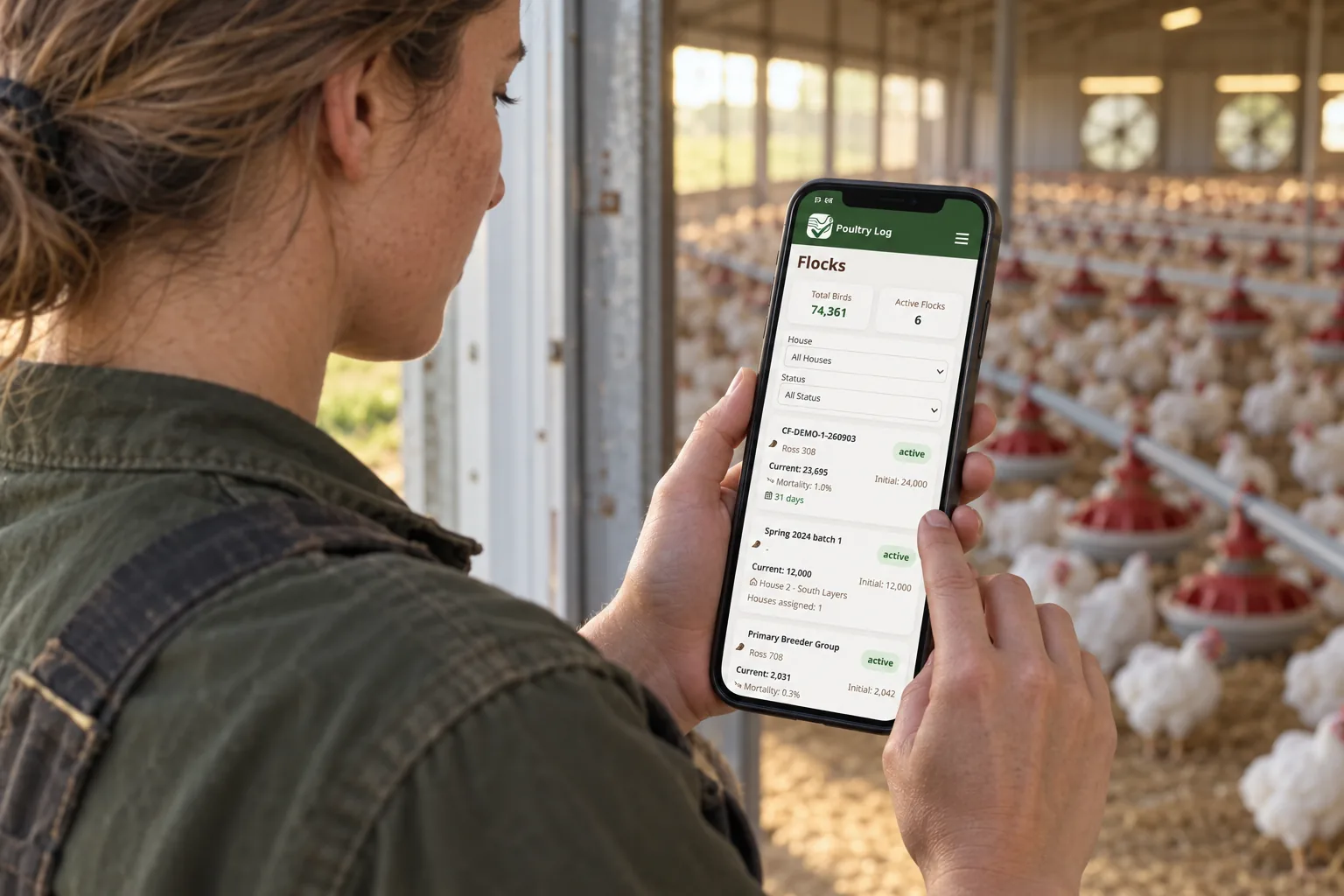
Poultry Log keeps the daily evidence the directive assumes: house-level logs with dates and times, mortality and cull records tied to flock and date, equipment and service history, and compliance checklists that can be structured to a region profile rather than a US state catalog — so an EU operation's records keep the shape its authority expects. When the register, the daily condition log, and the indicator observations live in the same system, the inspection stops being a document hunt and becomes a walkthrough with the records already on screen. The audit-ready guide covers the same preparation for third-party and processor audits.
- 2026-10-05: Initial version. Stocking density tiers, Annex I conditions, Article 10 register fields, inspection and indicator overview, preparation method — sourced to Directive 2007/43/EC and European Commission summaries.