
Why Record Keeping Separates Top Growers from Average Ones
The difference between a top-quartile grower and an average grower often comes down not to luck or genetics, but to information. Top performers know exactly what happened in every house during every flock because they wrote it down. Average growers rely on memory, and memory is unreliable when you manage multiple houses across multiple flocks per year.
Broiler record keeping is the practice of systematically capturing daily observations, measurements, and events for each house and flock and organizing them so they can be reviewed, compared, and acted upon. It is the foundation of every management improvement a grower can make.
What to Record Daily
Daily records should capture the data needed to evaluate flock health and performance. For each house, growers should record mortality counts by time of day with suspected cause for any abnormal losses, water meter readings that can be compared to expected consumption for bird age and temperature, feed delivery and consumption data for accurate FCR calculation, house temperature highs and lows, ventilation settings, and any health observations or treatments administered.
Recording these during the house walkthrough — not at the end of the day from memory — improves accuracy significantly. A system that takes less than five minutes per house per day is ideal.
What to Record Per Flock
Flock-level records provide the big picture. For each flock, growers should record placement date, breed, and chick source, final placement count and actual start count, daily and cumulative mortality, total feed delivered and consumed by phase, feed conversion ratio calculated at settlement, processing plant results including average weight, live weight per square foot, condemnation rates, and foot pad scores, vaccination and treatment records, and total flock expenses and income for profitability calculation.
These records become the basis for comparing performance across flocks and identifying trends that need attention.
The Economics of Better Records
Investing time in record keeping pays measurable dividends. Growers who track daily mortality catch disease outbreaks 24 to 48 hours earlier, reducing total mortality by an estimated 0.5 to 1 percentage point per flock. Those who track FCR and compare it across houses identify ventilation, feed, or health problems sooner. Those who track expenses by flock know exactly which costs are eroding margins.
For a farm producing 200,000 birds per year at $0.06 per pound, a 0.5 percent mortality reduction saves approximately $3,000 per year in lost birds alone, and the FCR improvement from better management visibility saves several times that in feed costs.
Paper vs Digital Records
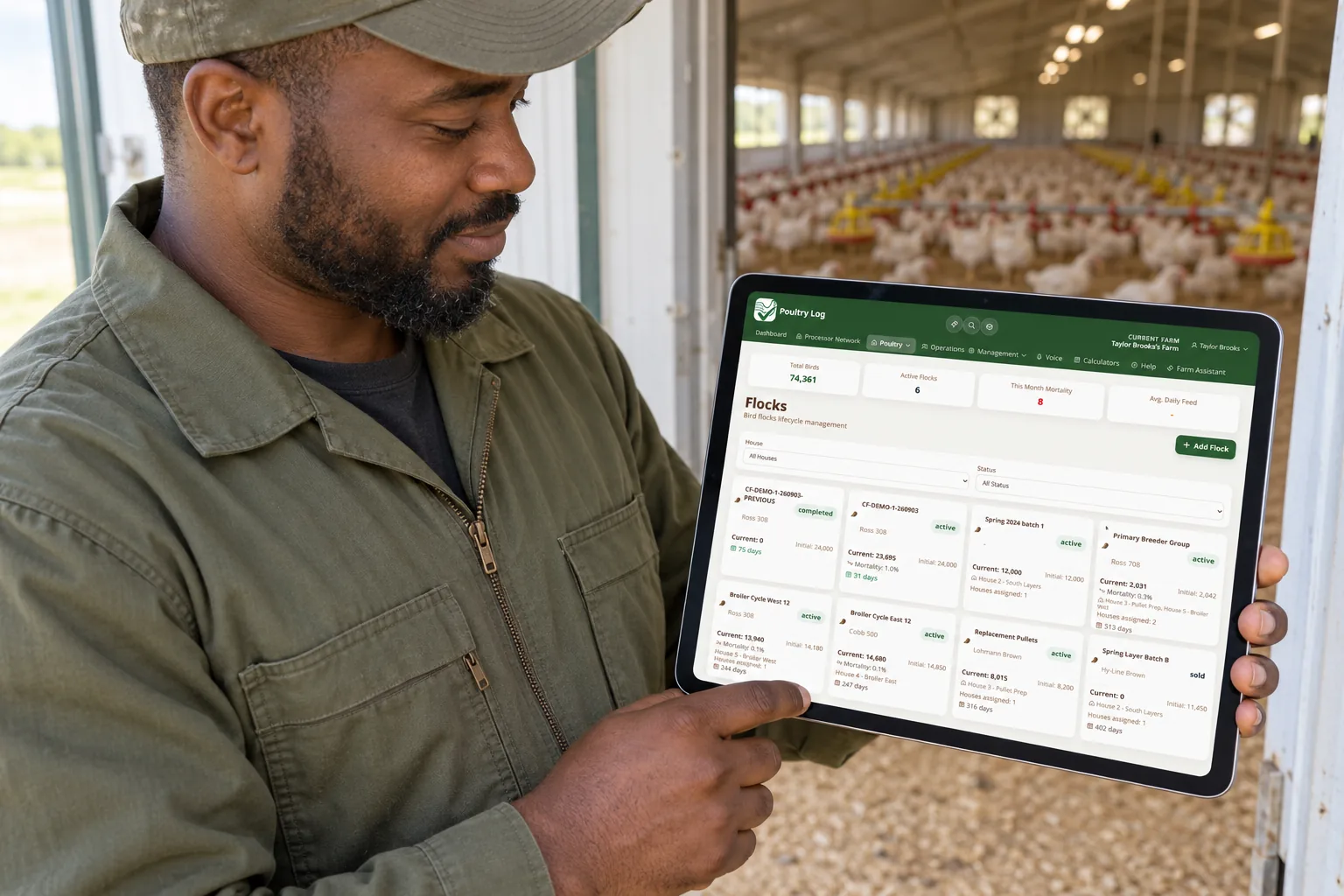
Paper record keeping is better than nothing, but it has significant limitations. Paper records are hard to search, easy to lose, difficult to analyze across flocks, and time-consuming to organize for audits. Digital record keeping solves these problems by making records searchable, automatically trendable, and always accessible.
Digital systems also enable features that paper cannot match: automated alerts when water consumption drops, trend charts comparing houses, expense aggregation per flock, and one-click compliance reports. For most growers, the time saved by digital record keeping exceeds the time invested in data entry within the first flock cycle.
Building a Record Keeping Habit
Consistency matters more than complexity. A simple system used daily outperforms a sophisticated system used sporadically. The key is making record keeping part of the daily walkthrough routine rather than a separate task done at the end of the week from memory. Growers who log data while they are in the house capture more detail and fewer errors than those who try to reconstruct the day later.
Building the Record-Keeping Habit
Consistency matters more than complexity. A grower who records mortality, water consumption, and feed usage daily using a simple system has better data than a grower who maintains an elaborate system inconsistently. The key is building the habit of recording data during each house walkthrough, at the time of observation, rather than reconstructing records from memory at the end of the day. A system that supports quick, consistent daily recording will be maintained. A system that is burdensome or complex will be abandoned.