
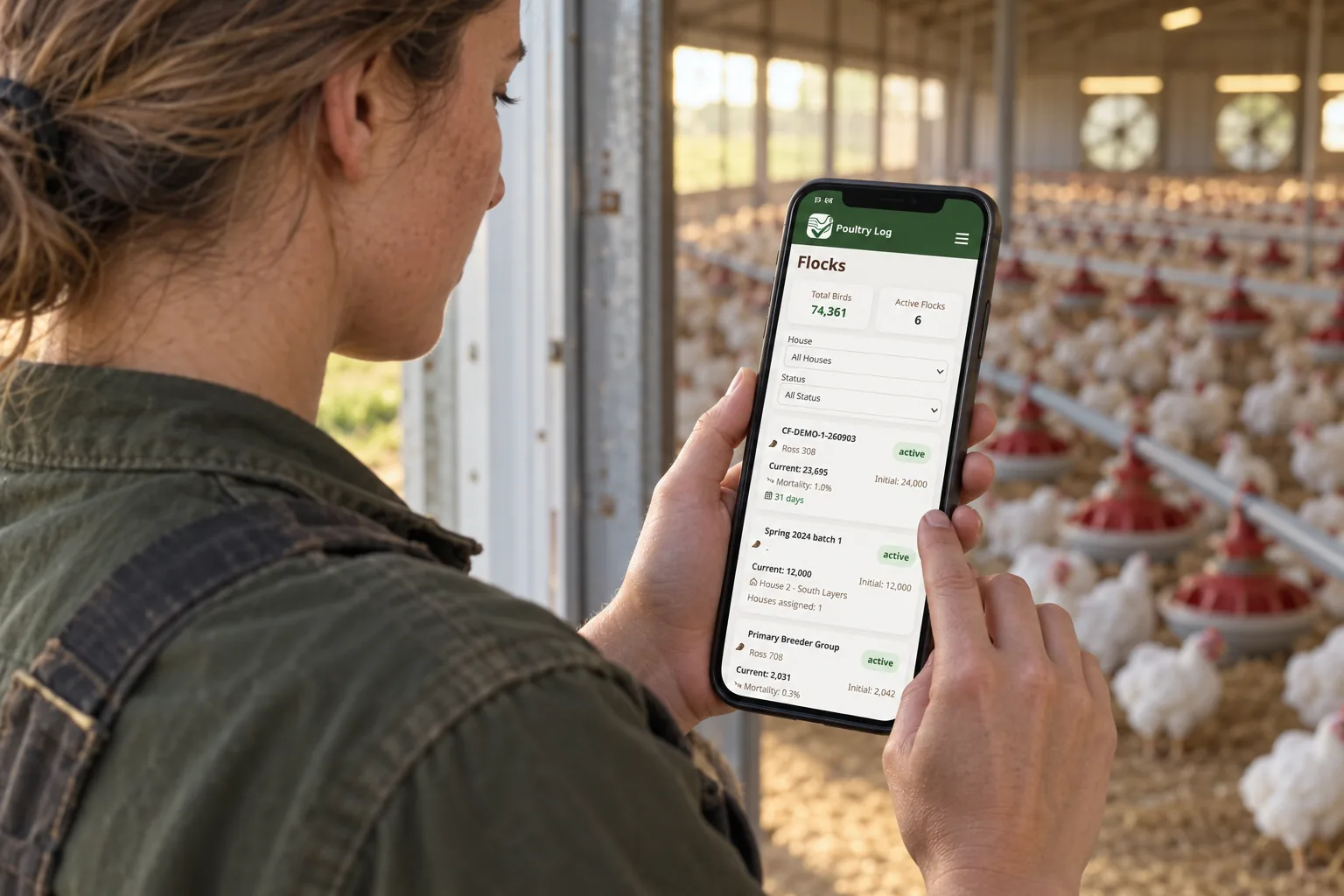
Flock health is not one metric — it is the story told by mortality, water, weight, treatments, and observations together. A flock-health app earns its place when those logs sit on one timeline, so a health event can be read against what moved before it: the water dip, the intake drop, the weight stall. This page covers what flock-health tracking demands for poultry specifically, what to verify in any app, and where PoultryLog™'s record set stands against those demands.
What Does Flock-Health Tracking Demand?
| Demand | Why It Matters | What to Verify in Any App |
|---|---|---|
| One timeline for every signal | Health events have antecedents — water, feed, weight, mortality moved first; the app that shows them together turns symptoms into causes | Confirm mortality, water, feed, weight, and treatments share one timeline per house |
| Daily observations with time and house | The soft signals — panting, ruffled birds, uneven flock, wet litter — are seen in the house, and they fade from memory in hours | Log an observation on mobile; check it appears with time and house attached |
| Treatment records with structured fields | Product, batch, dose, dates, withdrawal — the record set that supports both health review and food safety | Log a treatment in the demo; confirm batch and withdrawal fields export |
| Deviation alerts against your own baseline | Health problems announce themselves as deviation — a water drop, an intake dip, a mortality rise — before they announce themselves as sick birds | Ask whether alerts compare to your flock's own history or only static targets |
| Retrieval that survives an investigation | When a veterinarian or integrator asks "what moved in house 2 last week?", the answer must take minutes | Run the drill: one house, one week, every signal — time it |
What to Verify Before You Trust the Record
- Run the timeline test: ask the app to show one house's week — mortality, water, feed, weight, treatments. If they live in separate screens, the story lives in your head, and your head is not evidence.
- Time an observation entry: soft signals are seen in the house and lost in the office. If logging takes a minute, the record will not exist when it matters.
- Check the treatment fields: batch numbers and withdrawal dates as structured data, exportable — the same standard as the vaccination tracking demand.
- Confirm the alert question: does deviation mean "against your last 7 days" or "against a generic target"? Your own baseline is what makes an alert actionable instead of noisy.
Where PoultryLog™ Fits
PoultryLog™ keeps every health signal on one house-level timeline: mortality and culls with timestamps, water and feed against target curves, weight samples with CV%, treatments and vaccinations with batch numbers, and daily observations with time and place — with deviation alerts against the flock's own baseline. That structure is what the cause review and the heat stress guide assume: the signal that moved first is visible because every signal shares a timeline. It is strongest for contract broiler growers; for honest limits and other segments, see the buyer's guide. This page describes records and workflow — diagnosis and treatment decisions belong with your veterinarian.
Where the Money Shows Up
Flock-health records pay at the three moments that decide a season: early detection (a water or intake deviation caught in hours instead of days — on 30,000 birds, a health event caught a week early is the difference between treating a flock and losing a house's worth of birds), audit readiness (dated treatment and health records export for integrator and food-safety review — see the audit-ready guide), and settlement (health events and the records that documented them are what the settlement comparison reconciles against). The profitability dashboard carries what each health event actually cost per pound.
- Poultry management software buyer's guide — parent evaluation framework.
- Common broiler mortality causes — the cause-signature table.
- Water as early warning — the first signal to move.
- 2026-10-05: Comprehensive rewrite. One-timeline demand table, verification drill, and honest positioning under the buyer's guide — replacing the earlier self-ranking version.
- Earlier version: "best app" ranking with unverified competitor claims.