
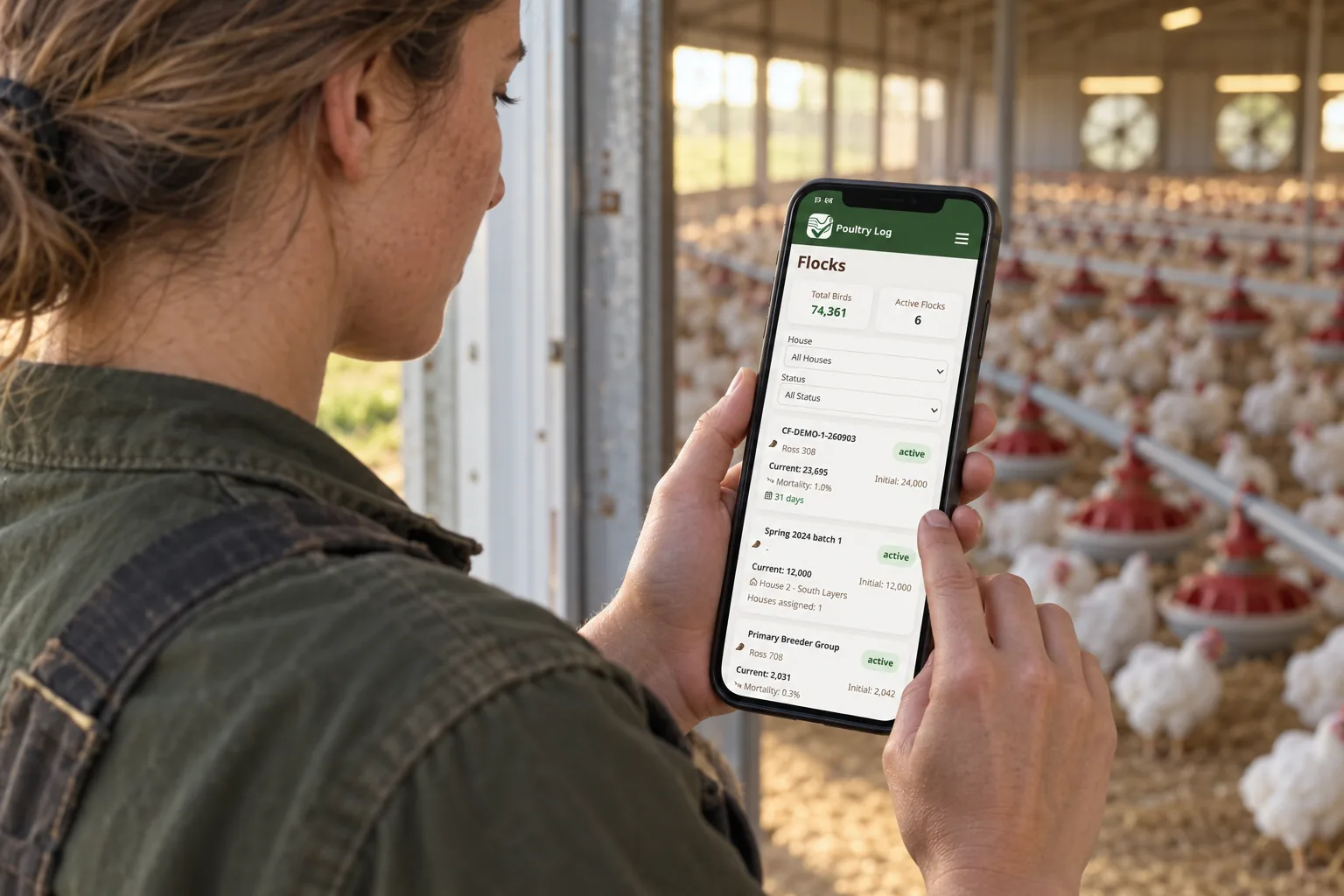
Profit tracking is where recordkeeping stops being storage and starts being management. A profit-tracking app earns its place when it connects expenses to the flock they belong to and computes what the flock actually earned — cost per bird, cost per pound, margin against settlement — instead of leaving you with an expense tab and a settlement sheet in different files. This page covers what profit tracking demands for poultry specifically, what to verify in any app before you trust its numbers, and where PoultryLog™'s record set stands against those demands.
What Does Poultry Profit Tracking Demand?
| Demand | Why It Matters for Poultry | What to Verify in Any App |
|---|---|---|
| Expenses tied to the flock, not the month | "Farm costs for April" cannot tell you which flock ate the money; per-flock attribution is the difference between a guess and a number | Tag an expense to a specific flock in the demo; confirm cost per bird computes from it |
| Cost per bird and cost per pound | The two metrics that compare flocks of different sizes and settle questions about which house earns its keep | Enter a completed flock's expenses and counts; check both metrics calculate automatically |
| Settlement income against the same flock | Margin is income minus cost on the same flock — if income lives in a separate system, margin is arithmetic you do by hand | Record settlement income against a flock; confirm the app shows margin, not just two totals |
| Break-even visibility | The break-even price is the line below which the flock lost money — knowing it after settlement is knowing it too late | Ask whether the app computes or surfaces break-even, or leaves it to you |
| Trend across flocks and seasons | One flock's margin is noise; the trend across flocks is what reveals creeping feed costs or a house that quietly underperforms | Request a multi-flock cost comparison in the demo |
What to Verify Before You Trust the Numbers
- Run the attribution test: enter an expense against one flock and confirm it does not appear in another's cost. Misattribution is the silent killer of profit tracking.
- Check the math: enter known expenses and counts; verify cost per bird and cost per pound compute correctly. One wrong formula poisons every comparison that follows.
- Ask where settlement income lands: if the app cannot record what the integrator paid against the same flock, you are tracking half the equation.
- Confirm export with flock attribution intact: profit records feed your accountant, your lender, and your own year-end review — they must export with the flock tags that make them meaningful.
Where PoultryLog™ Fits
PoultryLog™ ties expenses to the flock and house they belong to, computes cost per bird and cost per pound from those records, records settlement income against the same flock, and surfaces margin across flocks and seasons on the profitability dashboard. The break-even price and the settlement calculator extend the same record set into the decisions profit tracking exists to serve. It is strongest for contract broiler growers; for honest limits and other segments, see the buyer's guide.
Where the Money Shows Up
Profit tracking pays at three moments. During the flock: expense drift visible in week three is a rounding error; the same drift found at settlement is real money gone. At settlement: margin computed from your own records against the integrator's sheet is the independent comparison that settles disagreements. Across seasons: the trend shows which houses and which cost lines actually carry the operation — the number that justifies a feed-price negotiation or an equipment decision, per the budget template.
- Poultry management software buyer's guide — parent evaluation framework.
- Broiler break-even price — the formula and worked example.
- Poultry flock cost per bird — the per-flock metric in depth.
- 2026-10-05: Comprehensive rewrite. Demand table, verification drill, and honest positioning under the buyer's guide — replacing the earlier self-ranking version.
- Earlier version: "best app" ranking with unverified competitor claims.