
Spring care for turkeys diverges from the chickens' and ducks' springs in one defining vulnerability: blackhead disease. Turkeys are exquisitely susceptible to Histomonas meleagridis — the parasite carried by cecal worms and earthworms — and spring, when damp ground and free-ranging overlap, is when the exposure peaks. The second turkey-specific thread is maturation pace: turkeys grow slower and need more space per bird than chickens, and spring decisions (placement timing, housing, feed program) set the whole meat-bird economics. This page covers the turkey spring: blackhead risk management first, then the space and nutrition decisions that set the season.
The Turkey Spring Sequence
| Thread | What Turkeys Add To The Chicken Spring |
|---|---|
| Blackhead risk management | Blackhead (histomoniasis) spreads through cecal worms and earthworms — damp spring ground is the exposure corridor. Turkeys are far more susceptible than chickens; chickens can carry the parasite without showing it, which makes mixed flocks a transmission question (the worms guide covers the cecal-worm connection; the disease prevention guide covers the exposure-discipline logic) |
| Maturation and space | Turkeys grow slower and need more space per bird than chickens — spring placement decisions (how many, how fast, what housing) set the meat-bird economics the feed budget guide frames honestly (turkey feed conversion runs behind broiler chickens; the comparison belongs to the operation's market, not to a rule) |
| Environment reset and water | Shared threads from the chickens' spring guide apply — coop cleaning, water-system reopening (the water quality guide covers the spring test); turkey housing dries differently than chicken housing because of the birds' size and droppings volume |
| Flight awareness | Young turkeys fly better than chickens — spring housing decisions that ignore flight (open runs, low fencing) produce summer escape problems; the space guide covers the housing math, and wing management is a spring-timing question |
The Blackhead Discipline
- Ground exposure is the corridor. Blackhead reaches turkeys through cecal worms and the earthworms that carry them — damp, undisturbed ground is where the cycle lives. The worms guide covers the parasite side; the management response is exposure reduction, not folk treatment.
- Chickens as carriers. Chickens harbor the parasite without visible disease — a mixed flock means the turkey's exposure runs through the chickens' ground contact. The disease prevention guide covers the separation and management logic; the DE guide covers why folk remedies substitute for the fecal check that actually informs the program.
- Veterinary guidance is the program. Blackhead prevention and any treatment decisions belong with your veterinarian — this page covers the exposure discipline (ground management, flock separation, fecal checks), not the medical protocol.
The Money Connection
Turkey production economics differ from broiler economics in shape: slower growth, higher feed-per-pound, and a market window (holiday demand) that decides the placement calendar backwards from the sale date. The feed budget guide's framing applies with the turkey's own numbers; the pricing guide covers the cost-first method for direct-market birds. What spring management buys is the season's risk posture: blackhead exposure minimized, housing set for the growth pace, and the feed program matched to the bird the operation is actually raising.
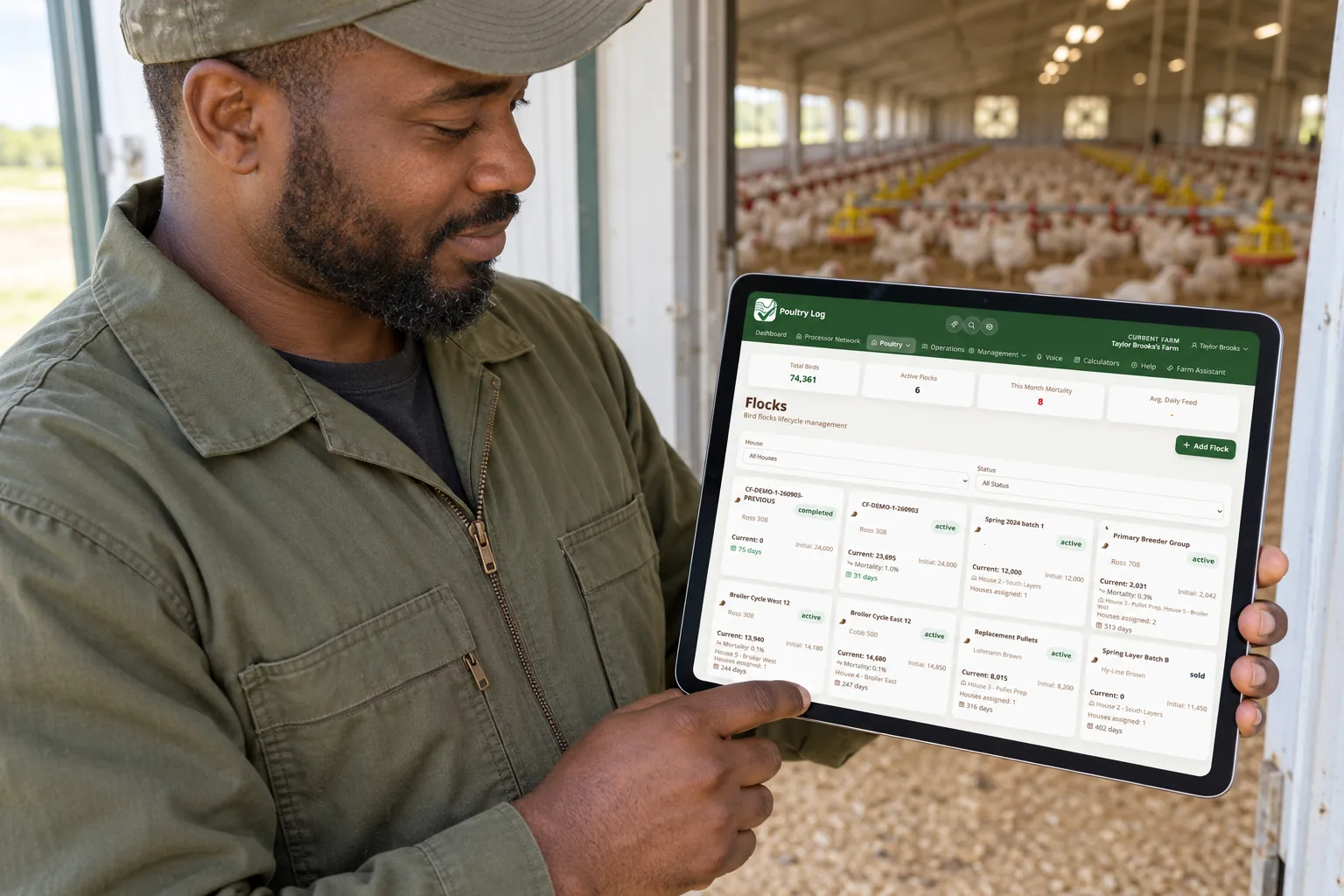
Tracking Turkey Records In Poultry Log™
Feed, water, health observations, and growth records on one timeline let the turkey season be measured against the last — the blackhead-risk indicators (ground conditions, flock separation, worm checks) and the growth-versus-feed-cost trajectory the economics run on. The chickens' spring guide covers the shared threads; the profitability dashboard carries the trend across flocks.
- 2026-10-06: Comprehensive rewrite — turkey spring sequence with blackhead-risk table, exposure-discipline section, and meat-bird economics framing — replacing the earlier boilerplate version.
- Earlier version: short first-person note on turkeys care in spring.