

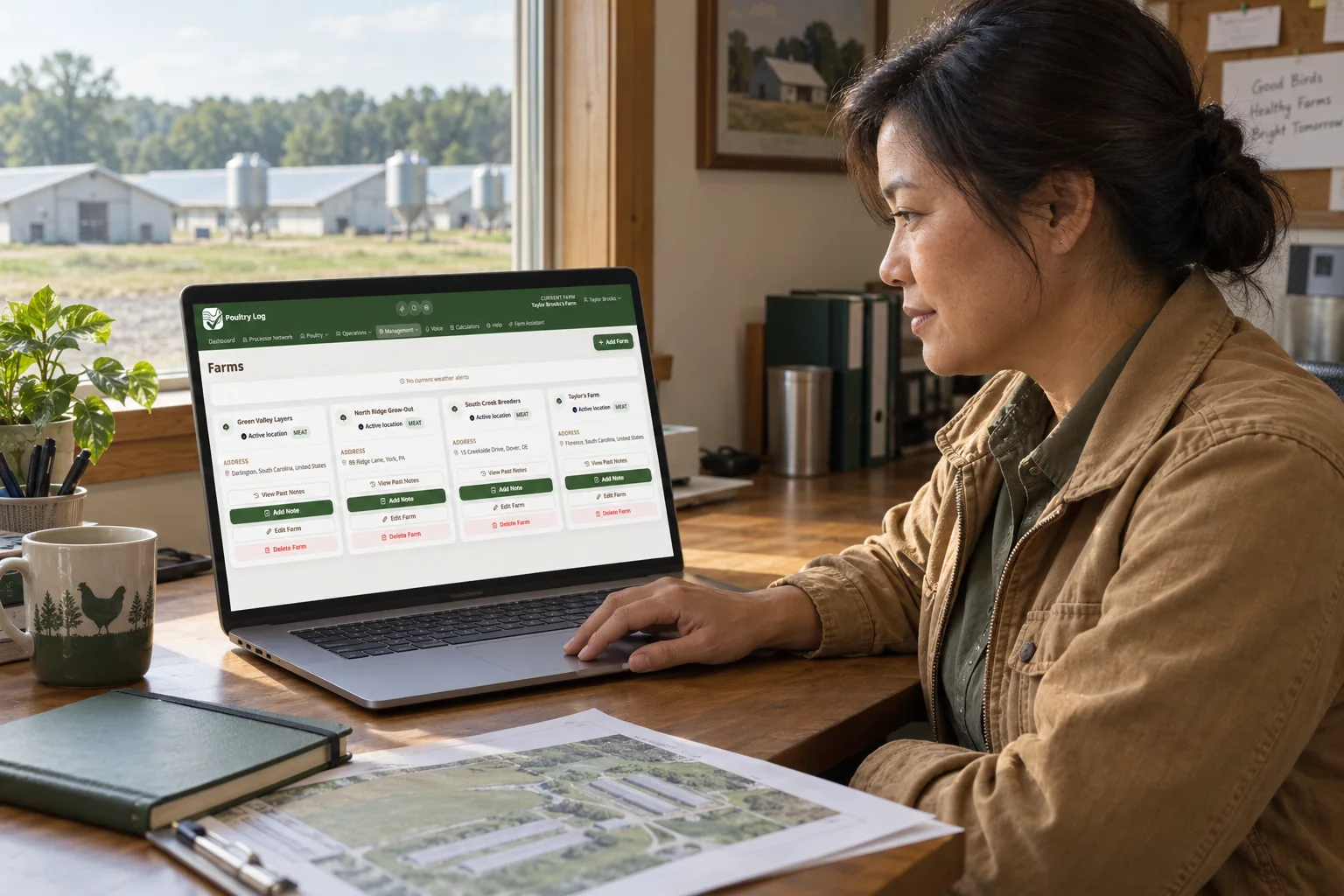
North Carolina is one of the largest broiler-producing states in the United States, and its compliance program reflects that scale: importation and exhibition health rules under the NCDA&CS Veterinary Division, hatchery and breeding-flock programs under N.C. Gen. Stat. Chapter 106, egg standards under Article 18, producer processing exemptions under Article 30, and a CAFO NPDES permit administered by the Department of Environmental Quality. Poultry Log's North Carolina catalog records each requirement with its agency, authority, cadence, retention, and official source link, reviewed against the NCDA&CS and NC DEQ program portals.
Animal Health Layer: NCDA&CS Veterinary Division
- Importation - poultry, hatching eggs, or other fowl entering North Carolina must meet Veterinary Division importation and health requirements under N.C. Gen. Stat. Chapter 106, Article 11, including a permit or certificate of veterinary inspection and any NPIP or Pullorum-Typhoid evidence required for the class of bird.
- Exhibitions - poultry exhibited at a North Carolina show must originate from a Pullorum-Typhoid-clean or NPIP-participating flock or have a negative Pullorum-Typhoid test within 90 days of the event, enforced at check-in. Birds from a participating NPIP flock may rely on program status instead of a separate test, but the documentation requirement still applies.
- Hatcheries and breeding flocks - a North Carolina hatchery, chick dealer, or seller of hatching eggs must participate in the state poultry health program under Article 33, keeping source, lot, and testing records. Chicks, poults, or hatching eggs offered for sale must come from Pullorum-Typhoid-clean or NPIP-participating breeding flocks, tested at least annually, with reactors removed.
- Reportable disease - a suspected or confirmed reportable poultry disease event, including avian influenza, must be reported immediately to the NCDA&CS Veterinary Division, with discovery, diagnosis, clinical signs, flock counts, laboratory evidence, and response measures kept with flock health records.
Mortality: Composting as an Approved Method
North Carolina's carcass disposal rule, under N.C. Gen. Stat. Chapter 106 and 15A NCAC 02D (solid waste), records mortality composting as an approved disposal method alongside burial, incineration, rendering, and other approved disposal. The duty is to dispose of carcasses promptly by an approved method so as not to create a public-health or environmental risk, with each disposal event recorded with date and time, method, location, counts, approved-method or permit reference, and any notification. The approved method depends on the operation type, location, and any integrator or local requirements.
Eggs, Processing, and CAFO Coverage
Under N.C. Gen. Stat. Chapter 106, Article 18 and 2 N.C. Admin. Code 52, a person who grades, candles, packages, or sells eggs as a dealer must be licensed as a North Carolina egg dealer and meet grading, candling, refrigeration, and labeling requirements; a producer selling only eggs from their own hens may operate under the producer exemption, but eggs must still be clean, wholesome, and honestly represented. For processing, a producer must use a licensed or USDA-inspected establishment unless every condition of North Carolina's producer or custom exemption is met, including processing only its own birds, sanitary conditions, required labeling, and any annual bird limits. On the environmental side, a poultry CAFO must obtain NPDES coverage under 15A NCAC 02H through NC DEQ Water Resources, implement a nutrient management plan, keep weekly inspection and land-application records commonly for five years, and submit the annual report under 40 CFR 122.42(e)(4).
Where Poultry Log Fits
Poultry Log's North Carolina catalog carries these requirements with official source links and form templates, in the same workspace as the daily records that feed them. The mortality composting context connects to the mortality and cull tracking guide, the egg layer to the wholesale egg dealer records guide, and the CAFO layer to the CAFO permit guide. Confirm current requirements with NCDA&CS and NC DEQ; completing a checklist does not certify legal compliance. Start free at poultrylog.com.
Frequently Asked Questions
What permits do North Carolina poultry farms need?
North Carolina layers duties across agencies: the NCDA&CS Veterinary Division for importation, exhibitions, hatcheries, breeding flocks, and reportable disease under N.C. Gen. Stat. Chapter 106; NCDA&CS Food and Drug Protection for egg dealer licensing and producer processing exemptions; and NC DEQ Water Resources for CAFO NPDES coverage under 15A NCAC 02H. Poultry Log's catalog records each requirement with its agency and official source.
Is mortality composting allowed in North Carolina?
Yes. The Poultry Log North Carolina catalog records mortality composting as an approved carcass disposal method under N.C. Gen. Stat. Chapter 106 and 15A NCAC 02D, alongside burial, incineration, rendering, and other approved disposal, with each disposal event recorded with date, method, location, counts, and any notification.
What are North Carolina's CAFO record retention periods?
Under 15A NCAC 02H, the catalog records that permits, applications, nutrient management plans, inspection and impoundment records, mortality-management records, overflow records, transfer records, and land-application records are kept for the period required by the permit, commonly five years, with the annual report submitted under 40 CFR 122.42(e)(4).