

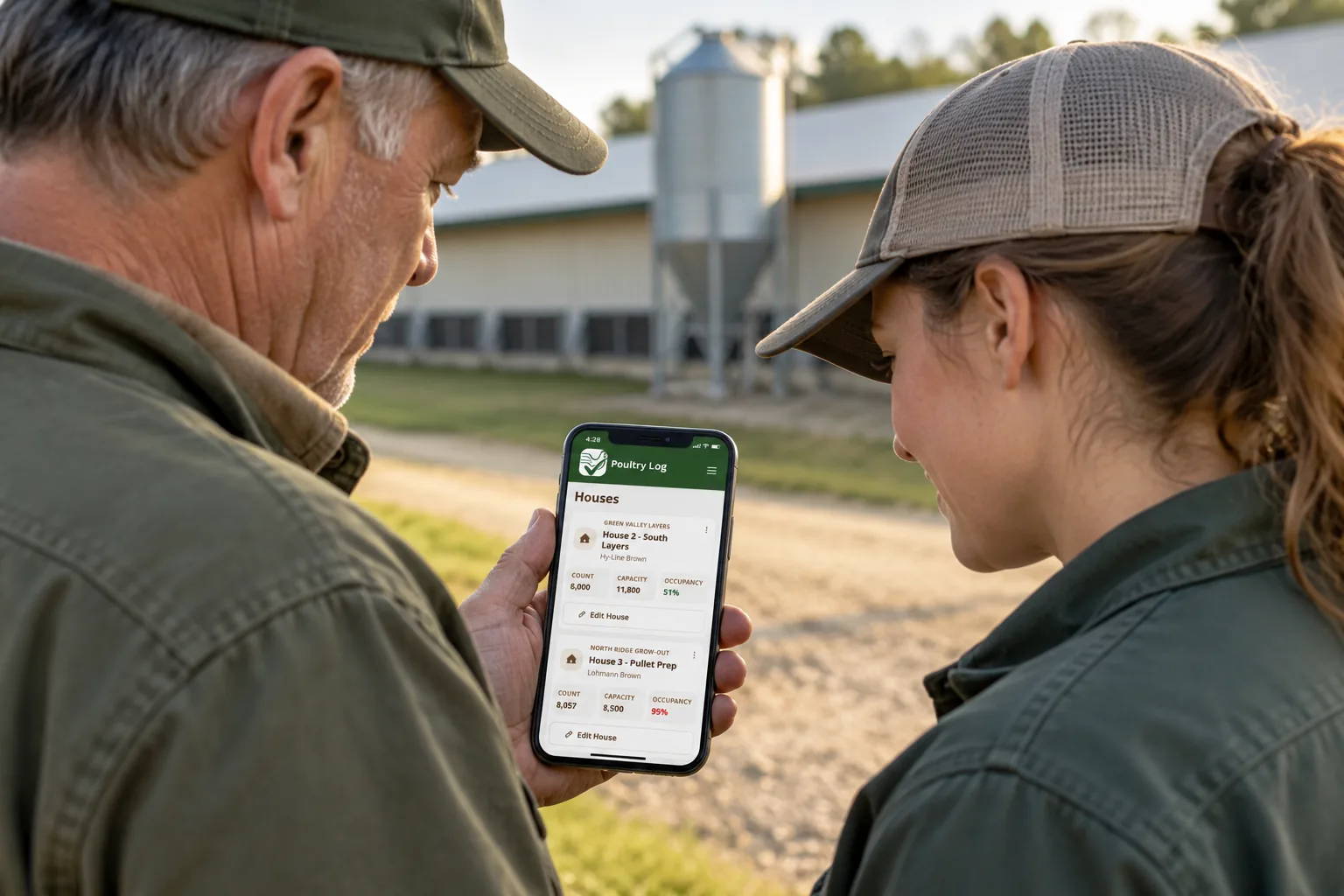
Mississippi's poultry compliance program is unusually specific in its animal health rules and unusually concrete in its mortality requirements. The Mississippi Board of Animal Health sets importation testing rules that name the test method and the bird count, runs a commercial avian-influenza surveillance plan with sampling schedules by production type, and requires commercial growers to hold a numbered mortality compliance certificate whose facility number goes to the integrator. The Mississippi Department of Agriculture and Commerce handles processing exemptions and egg marketing, and the Mississippi Department of Environmental Quality administers dry litter and CAFO general permits. Poultry Log's Mississippi catalog records each requirement with its agency, authority, cadence, retention, and official source link.
Animal Health Layer: Mississippi Board of Animal Health
- Importation testing - under 2 Miss. Admin. Code Pt. 101, R. 12.112, poultry entering Mississippi must have the required Pullorum-Typhoid, Mycoplasma, and shipment evidence. The catalog records the testing rule precisely: unless an NPIP avian-influenza clean or equivalent monitoring-plan waiver applies, test 20 birds per flock by PCR or AGID within 7 days before shipment. Live-poultry vehicles need a signed cleaning and disinfection certificate, and egg flats must be new or cleaned and disinfected plastic.
- Commercial avian-influenza surveillance - under R. 13.110.02, commercial poultry operations must participate in the state's surveillance plan for their production type: breeder qualification and quarterly sampling, commercial-layer egg sampling every 30 days from half of houses or an approved NPIP option, testing of affected broiler, pullet, and hen submissions, and the applicable commercial-broiler sampling pathway.
- Mortality certificate and mass mortality plan - under R. 13.105.01-.09, a commercial grower must use a Board-approved incinerator, compost system, freezer, or other approved method; obtain and maintain the numbered compliance certificate and disposal-facility permit number; and provide that number to the integrator. Every commercial grower must also maintain the Board-developed, NRCS-implemented mass mortality disposal plan. Catastrophic losses require an emergency disposal permit, and normal commercial-poultry disposal pits may not be newly dug.
- Exhibitions and disease notice - exhibited chickens and turkeys must originate from a U.S. Pullorum-Typhoid Clean flock or have a negative test within 90 days, with a certificate of purchase for each entered bird. A diagnosis, field diagnosis, or suspicion of infectious laryngotracheitis must be reported immediately to the State Veterinarian.
Processing and Egg Layer: MDAC
Mississippi's processing exemptions are two-tiered. Under Miss. Code Ann. Sections 75-33-3(4) and 75-33-7, a producer using the 1,000-bird or 20,000-bird poultry exemption must apply for establishment registration, keep slaughter, purchase, and customer-sales records, slaughter only qualifying healthy poultry of its own raising within the annual limit, use the required exempt label, and limit sales to preordered on-farm pickup or qualifying in-state home delivery. The catalog records that exempt poultry may not be sold into commerce or at a farmers market, and that the 20,000-bird pathway also requires a compliant building and sanitation controls. On the egg side, a person owning more than 3,000 hens, or selling eggs to a Mississippi retailer, must secure the Egg Marketing License before offering or selling those eggs, expiring June 30 each year, with covered eggs subject to the state per-case assessment. Nonexempt shell eggs must meet a U.S. consumer grade and size, remain at ambient temperature no greater than 45 degrees Fahrenheit, and use a consumer container showing grade, size, count, producer or packer name and address, pack date, and refrigeration statement, with any expiration date no more than 30 days from packing.
Environmental Layer: MDEQ
Mississippi runs two general permits for poultry. The Dry Litter Poultry AFO General Permit MSG20 covers dry-litter broiler and egg operations with no process wastewater discharge and no waste or raw material exposed to stormwater, requiring written coverage before operation, a nutrient management plan, annual litter analysis, soil analysis at least once every five years, and land-application, litter-transfer, and mortality records kept five years. The Multimedia CAFO General Permit MSG22 covers qualifying or designated poultry CAFOs, recording the large dry-manure thresholds as 125,000 chickens other than laying hens, 82,000 laying hens, or 55,000 turkeys, requiring a current Comprehensive Nutrient Management Plan, weekly production-area inspections, and five-year record retention. Covered CAFOs submit their annual report to the Permit Board by January 28, with electronic submission required under 40 CFR 127.16 after December 20, 2025.
Where Poultry Log Fits
Poultry Log's Mississippi catalog carries these requirements with official source links and form templates, including the mortality certificate, mass mortality plan, avian influenza surveillance record, and MSG20/MSG22 record sets. The mortality layer connects to the mortality and cull tracking guide, the surveillance layer to the avian influenza testing guide, and the CAFO layer to the CAFO permit guide. Confirm current requirements with MBAH, MDAC, and MDEQ; completing a checklist does not certify legal compliance. Start free at poultrylog.com.
Frequently Asked Questions
What avian influenza testing does Mississippi require for incoming poultry?
Under 2 Miss. Admin. Code Pt. 101, R. 12.112, poultry entering Mississippi must have the required Pullorum-Typhoid, Mycoplasma, and shipment evidence, and unless an NPIP avian-influenza clean or equivalent monitoring-plan waiver applies, 20 birds per flock must be tested by PCR or AGID within 7 days before shipment. Live-poultry vehicles need a signed cleaning and disinfection certificate.
What is the Mississippi mortality compliance certificate?
Under R. 13.105.01-.09, a commercial grower must obtain and maintain a numbered compliance certificate and disposal-facility permit number for an approved mortality method (incinerator, compost system, freezer, or other approved method), provide that number to the integrator, and maintain the Board-developed mass mortality disposal plan. Normal commercial-poultry disposal pits may not be newly dug, and catastrophic losses require an emergency disposal permit.
When is the Mississippi CAFO annual report due?
Under Multimedia CAFO General Permit MSG22, each covered CAFO must submit its annual report to the Permit Board by January 28, covering animal inventory, manure and wastewater generated and transferred, nutrient-plan and applied acreage, discharges, and CNMP certification, with electronic submission required under 40 CFR 127.16 after December 20, 2025.