
Michigan's poultry compliance program is run almost entirely through one agency: the Michigan Department of Agriculture and Rural Development, which splits the work across Animal Industry, Fairs and Exhibitions, Livestock Markets, and Food and Dairy divisions, with the Department of Environment, Great Lakes, and Energy handling CAFO coverage. Michigan's catalog carries details the other state modules do not: intrastate temporary-location movement rules that name swap meets and flea markets by word, an ILT-vaccination permission rule that stops most vaccinated poultry at the state line without State Veterinarian approval, a dead-bird composting standard built on heat cycles, and a general CAFO permit that excludes egg processing and washing facilities by name.
Animal Health Layer: MDARD Animal Industry
- Imports - poultry or hatching eggs entering Michigan must travel with an interstate CVI issued after inspection within 30 days, an eligible NPIP VS Form 9-3, or an owner-shipper statement for direct slaughter, under the Animal Industry Act, 1988 PA 466. Unless exempt, every bird must have a negative official Salmonella pullorum-typhoid test within 90 days, and the CVI must state the test, date, and negative result. The catalog records a vaccine-specific rule that trips up prepared growers: most ILT-vaccinated poultry need State Veterinarian permission unless an approved vector vaccine is documented. Pigeons and doves are exempt from the test, but not the entry document.
- Temporary-location movements - poultry moved within Michigan to a temporary location such as a shelter, rescue, swap meet, flea market, or feed store must carry documentation of a negative pullorum-typhoid test completed within 90 days and remain isolated from poultry of unknown or positive status. NPIP clean-flock evidence, movement to a licensed auction for slaughter poultry, and open-air stays under 24 hours where commingling is prevented are exempt from additional testing, and direct origin-to-final-destination intrastate movement has no specific poultry document requirement.
- Composting mortalities - under the Bodies of Dead Animals Act, 1982 PA 239 and Mich. Admin. Code R 287.651 et seq., an animal production operation composting normal natural daily mortality must add dead birds to a compost batch within 24 hours, monitor and record internal batch temperature at least weekly, complete at least three heat cycles, and maintain a five-year batch record; rotating-drum continuous-flow systems require temperature checks twice weekly. The catalog records the boundary: only normal natural daily mortality under common ownership may use the ordinary farm pathway, any unusual increase in mortality must be reported immediately, and affected tissue may not be composted without the MDARD Director's permission.
Food Safety and Processing: MDARD Food and Dairy
MDARD's Food and Dairy Division handles egg and processing licensing under federal meat and poultry inspection guidance, and the catalog records the processing pathway structure: poultry processed for sale comes from a licensed state establishment or USDA-inspected operation unless every condition of an exemption is met, with the batch records showing facility license, USDA inspection or exemption basis, annual count, batch date and time, bird source and count, sanitation and temperature controls, and label and sale.
Environmental Layer: EGLE
A covered Michigan CAFO must obtain a Certificate of Coverage or individual NPDES permit and implement a certified Comprehensive Nutrient Management Plan under Part 31 of NREPA, 1994 PA 451, through NPDES General Permit MIG010000, effective October 29, 2025 through October 28, 2030. The catalog records the general permit's exclusions precisely: it excludes new poultry facilities with contaminated areas exposed to precipitation, egg processing, egg washing, and duck facilities, which require an individual permitting determination instead. Operating records under the permit include weekly waste storage structure inspections with deficiencies and corrective actions, Daily Manure Application Records, Land Application Logs, the state manifest for covered offsite waste transfers (excluding transfers below one pickup load, one cubic yard, or one ton per recipient per day), quarterly summaries, and the preceding calendar year CAFO annual report due April 1, all retained at least five years from creation.
Where Poultry Log Fits
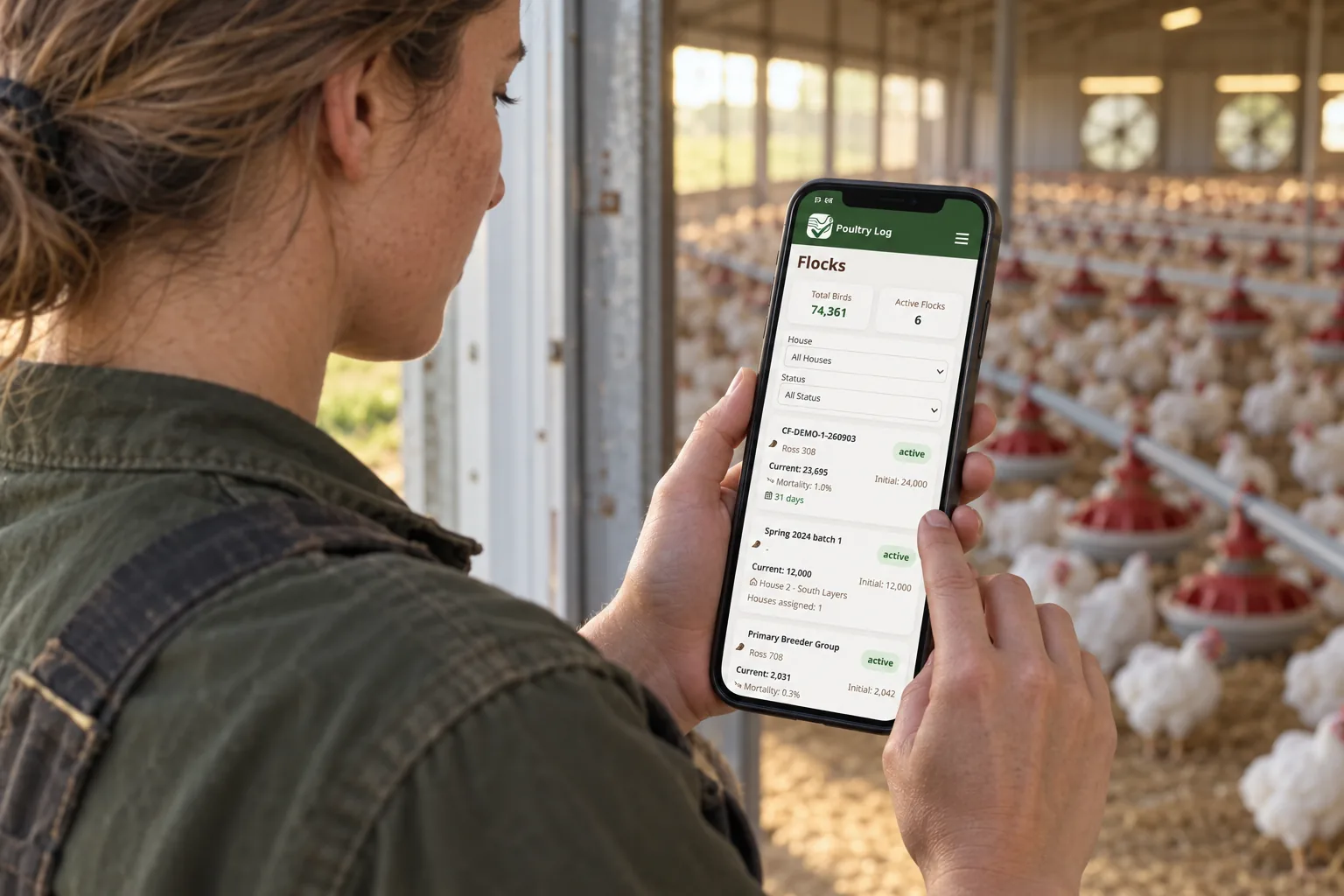
Poultry Log's Michigan catalog carries these requirements with official source links and form templates, in the same workspace as the daily records that feed them. The compost batch records connect to the mortality and cull tracking guide, the temporary-movement rules to the avian influenza testing guide, and the CAFO layer to the CAFO permit guide. Confirm current requirements with MDARD and EGLE; completing a checklist does not certify legal compliance. Start free at poultrylog.com.
Frequently Asked Questions
What records does Michigan require for on-farm poultry composting?
Under the Bodies of Dead Animals Act and Mich. Admin. Code R 287.651 et seq., dead birds must be added to a compost batch within 24 hours, internal batch temperature recorded at least weekly, at least three heat cycles completed, and a five-year batch record maintained, with rotating-drum systems requiring temperature checks twice weekly. Unusual mortality increases must be reported immediately, and affected tissue may not be composted without MDARD Director permission.
Do ILT-vaccinated poultry need permission to enter Michigan?
Most do. The Poultry Log Michigan catalog records that ILT-vaccinated poultry need State Veterinarian permission unless an approved vector vaccine is documented, under the Animal Industry Act and current MDARD poultry movement requirements. The entry document and pullorum test requirements apply on top of that.
What does Michigan's CAFO general permit exclude?
NPDES General Permit MIG010000, effective October 29, 2025 through October 28, 2030, excludes new poultry facilities with contaminated areas exposed to precipitation, egg processing, egg washing, and duck facilities, which require an individual permitting determination instead. Covered CAFOs submit the annual report by April 1 and keep operating records at least five years.