
Kansas's poultry compliance program runs through four agencies that each carry their own clocks and thresholds, and the numbers are the story. The Kansas Department of Agriculture handles bird health, eggs, and processing; the Department of Health and Environment runs confined-feeding registration and waste permits off animal-unit math; the KDA Division of Water Resources runs a permit system measured in acre-feet; and the reporting clocks are some of the tightest in the catalog: a reportable waste event needs a telephone call within two hours and a written report within three days.
Animal Health and Trade: KDA Division of Animal Health
- Imports - poultry entering Kansas must travel with a CVI or VS Form 9-3 and the applicable one-time, annual paper-shipment, or electronic NPIP permit authorization under K.A.R. 9-7-1 and 9-9-1 through 9-9-4 and K.S.A. 47-610. Adult poultry other than waterfowl must originate from a Pullorum-Typhoid-clean flock or test negative within 90 days before entry. The catalog records a workflow shortcut: electronic NPIP VS Form 9-3 submissions do not need an additional paper permit.
- Exhibitions - every chicken, turkey, and game bird shown at a Kansas exhibition must be accompanied by an approved certificate or test chart showing origin from an NPIP Pullorum-Typhoid-clean hatchery or breeding flock, or a negative test within 90 days before the exhibition opens. Out-of-state entries must also satisfy Kansas import requirements.
- Disease reporting - a person who knows or suspects poultry are affected by a reportable infectious or contagious disease, including avian influenza or virulent Newcastle disease, must report the facts to the Kansas animal health commissioner under K.S.A. 47-622 and K.A.R. 9-2-1.
Egg Layer: The Hen-Count Tiers
Under the Kansas Egg Law at K.S.A. 2-2508, a person selling, distributing, or grading eggs must license each place of business through December 31 and retain three years of quantity records. The catalog records the producer tiers precisely: a producer with 50 or fewer hens may sell own ungraded eggs without the license; a producer with 51 through 249 hens qualifies only for clean, labeled, refrigerated direct-to-consumer sales. Graded eggs remain subject to the Act regardless. On the fee side, the last handler of graded eggs sold or distributed in Kansas accounts for an inspection fee of 3.5 mills per dozen and files the quarterly report and payment under K.S.A. 2-2509, unless the fee is satisfied using authorized egg stamps, with reports, stamp purchases, dozen totals, and payment evidence kept three years.
Environmental Layer: KDHE and Water Resources
A confined feeding facility with capacity of 300 or more animal units must register with KDHE before new construction under K.S.A. 65-171d(g) and K.A.R. Article 28-18, and a facility requiring a designed waste-control structure or having daily wastewater discharges must register regardless of size. At 1,000 or more animal units, or at any size when KDHE finds significant water-pollution potential, a water-pollution-control permit is required, with federally permitted CAFOs implementing a nutrient management plan. A permitted poultry CAFO inspects and operates waste controls, documents manure and nutrient management, keeps the permit current through closure, and submits the operations and annual report required by its permit, generally keeping records at least five years. A permit reportable emergency, spill, accidental discharge, overflow, or unplanned release of animal or process waste must be reported to KDHE by telephone immediately upon discovery and within two hours, followed by a written report within three days. On water, a confined livestock operation diverting 15 or more acre-feet in a calendar year must obtain a permit or hold a vested water right under the Kansas Water Appropriation Act at K.S.A. 82a-701 et seq., and the owner of a non-domestic water right or permit must file a complete annual water-use report, including a reason for nonuse, by March 1 of the following year. Processing follows the 1,000-bird and 20,000-bird producer/grower registration tiers under the Kansas Meat and Poultry Inspection Act and KDA MP-19.
Where Poultry Log Fits
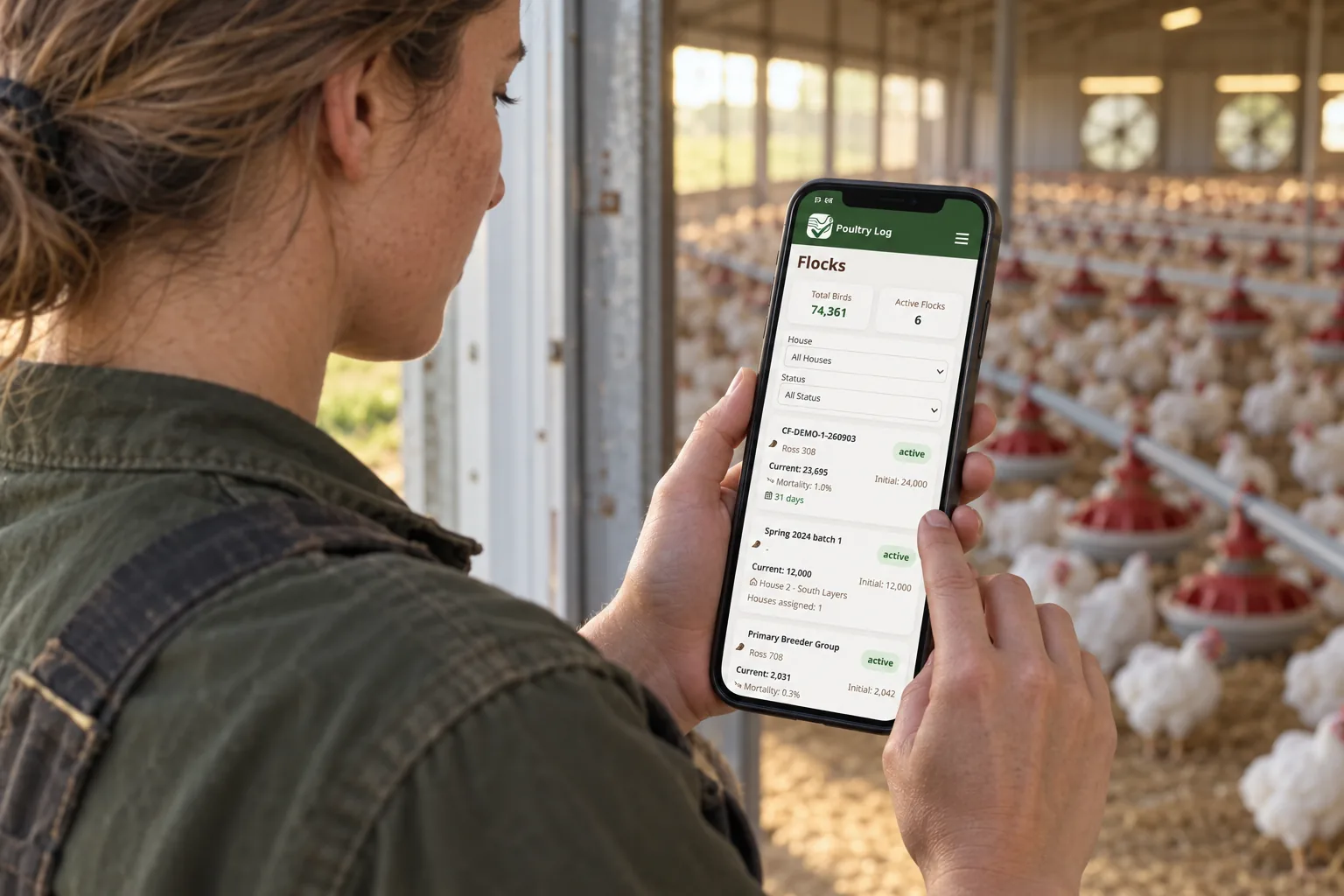
Poultry Log's Kansas catalog carries these requirements with official source links and form templates, in the same workspace as the daily records that feed them. The two-hour event clock connects to the Indiana guide, the water appropriation to the water withdrawal guide, and the egg tiers to the wholesale egg dealer records guide. Confirm current requirements with KDA and KDHE; completing a checklist does not certify legal compliance. Start free at poultrylog.com.
Frequently Asked Questions
How fast must a Kansas livestock waste event be reported?
A permit reportable emergency, spill, accidental discharge, overflow, or unplanned release of animal or process waste must be reported to KDHE by telephone immediately upon discovery and within two hours, followed by a written report within three days, under K.A.R. 28-18-1, 28-18-8, and 28-18-10 and the applicable Kansas or NPDES permit.
When does a Kansas confined feeding facility need to register?
Under K.S.A. 65-171d(g) and K.A.R. Article 28-18, at 300 or more animal units before new construction, and regardless of size when the facility requires a designed waste-control structure or has daily wastewater discharges. A water-pollution-control permit is required at 1,000 or more animal units, or at any size when KDHE finds significant water-pollution potential.
What are Kansas's egg producer license tiers?
Under K.S.A. 2-2508, a producer with 50 or fewer hens may sell own ungraded eggs without a license; a producer with 51 through 249 hens qualifies only for clean, labeled, refrigerated direct-to-consumer sales; and anyone selling, distributing, or grading eggs otherwise must license each place of business, with three years of quantity records retained.