
Florida's poultry compliance program is the most operationally specific in the Poultry Log catalog, and it earns that distinction honestly. The state's rules carry numbers that decide everything: a poultry import permit is valid for 15 days, an intrastate hauler stops at agricultural inspection stations, a limited poultry operation caps at 20,000 own-farm birds per year and 384 dressed birds per week, a dealer threshold starts at 30 dozen eggs or 384 dressed birds per week, and a mortality exemption covers 500 or fewer birds. The Florida Department of Agriculture and Consumer Services runs the animal health, food safety, and egg programs; the Florida Department of Environmental Protection runs the wastewater and monitoring duties. Poultry Log's Florida catalog records each requirement with its agency, authority, trigger, retention period, and official source link.
Movement: Import Permits and Intrastate Stops
- Imports - domestic fowl, poultry, and hatching eggs entering Florida generally need prior permission plus an Official Certificate of Veterinary Inspection or NPIP VS Form 9-3 and the applicable Pullorum-Typhoid and avian-influenza evidence, under Fla. Admin. Code r. 5C-3.012. The catalog records the permit clock precisely: a poultry import permit is valid for 15 days.
- Intrastate transport - vehicles moving poultry within Florida must stop at agricultural inspection stations and present proof of Florida residency and ownership or a bill of lading, under Fla. Admin. Code rr. 5C-3.012 and 5C-16.021. Ordinary intrastate movement does not require an OCVI or testing, but an activated avian-influenza movement order can add OCVI or VS Form 9-3 and testing requirements on top of the station stop.
- Exhibitions - poultry admitted to a Florida exhibition must have the required timely OCVI or exhibition inspection and originate from a Pullorum-Typhoid Clean flock or hatchery or have a negative test within 90 days, under Fla. Admin. Code r. 5C-4.004.
- Reportable disease - a person who knows or has reason to suspect a listed dangerous transmissible poultry disease, including avian influenza, must report it immediately to the Florida State Veterinarian under Fla. Stat. s. 585.18 and Fla. Admin. Code r. 5C-20.002.
Mortality, Food Permits, and the Limited-Operation Numbers
Florida's mortality rule at Fla. Stat. s. 583.181 requires producers, egg producers, and hatcheries to dispose of dead birds and hatchery residue by an authorized sanitary method, with off-premises transport in sealed containers. The catalog records the exemption precisely: poultry and egg producers with 500 or fewer birds are exempt unless the Department determines a disease threat, and the exemption does not extend to hatcheries. On the food safety side, the limited poultry and egg permit under Fla. Admin. Code r. 5K-4.033 carries hard caps: a limited poultry operation may process no more than 20,000 own-farm birds per year and no more than 384 dressed birds per week; a limited egg operation may keep no more than 3,000 hens and sell fewer than 30 dozen eggs per week. A food permit and initial inspection are required, and the permit does not authorize wholesale, mail-order, broker or dealer sales, additional processing, or interstate poultry sales. The application and renewal must also document approved water and sewage disposal: a private-well alternative requires a qualifying third-party sample, laboratory results within six months, and current well-head photographs within four weeks. A dealer, under Fla. Stat. ss. 500.12, 583.01, and 583.09, includes a covered business selling or handling 30 dozen or more eggs per week or more than 384 dressed birds per week, and must hold the applicable food permit, keeping two years of invoices, manifests, bills of lading, and transaction records identifying parties, quantity, source, grades, and standards.
Eggs, Labels, and the Environmental Layer
Shell eggs must be handled under Florida's pack-date, grade, size, identity, nest-run, and advertising rules and refrigerated at an ambient temperature of 45 degrees Fahrenheit or less after packaging until retail sale or use, under Fla. Stat. ss. 583.02, 583.021, and 583.022. Dressed poultry sales must use the prescribed bulk, unpackaged-retail, or packaged-retail statement of grade, part or whole bird, weight where required, and dealer name and address, under Fla. Stat. s. 583.13. On the environmental side, a major egg production facility, generally more than 100,000 laying hens, more than 30,000 with liquid manure, or onsite egg processing equal to 100,000 hens per day, must obtain the required wastewater permit from Florida DEP under Fla. Admin. Code r. 62-670.600, and every major egg facility must implement the approved groundwater monitoring plan, sampling wells for total nitrogen, nitrate, fecal coliform, specific conductance, pH, and groundwater depth on a quarterly basis. A CAFO discharging or proposing to discharge wastewater must apply for a Florida DEP permit under Fla. Admin. Code rr. 62-670.200 and 62-670.400, and agricultural producers in adopted Basin Management Action Plan areas must implement the adopted poultry BMPs or conduct the required water-quality monitoring under Fla. Stat. s. 403.067, with FDACS implementation verification at least every two years.
Where Poultry Log Fits
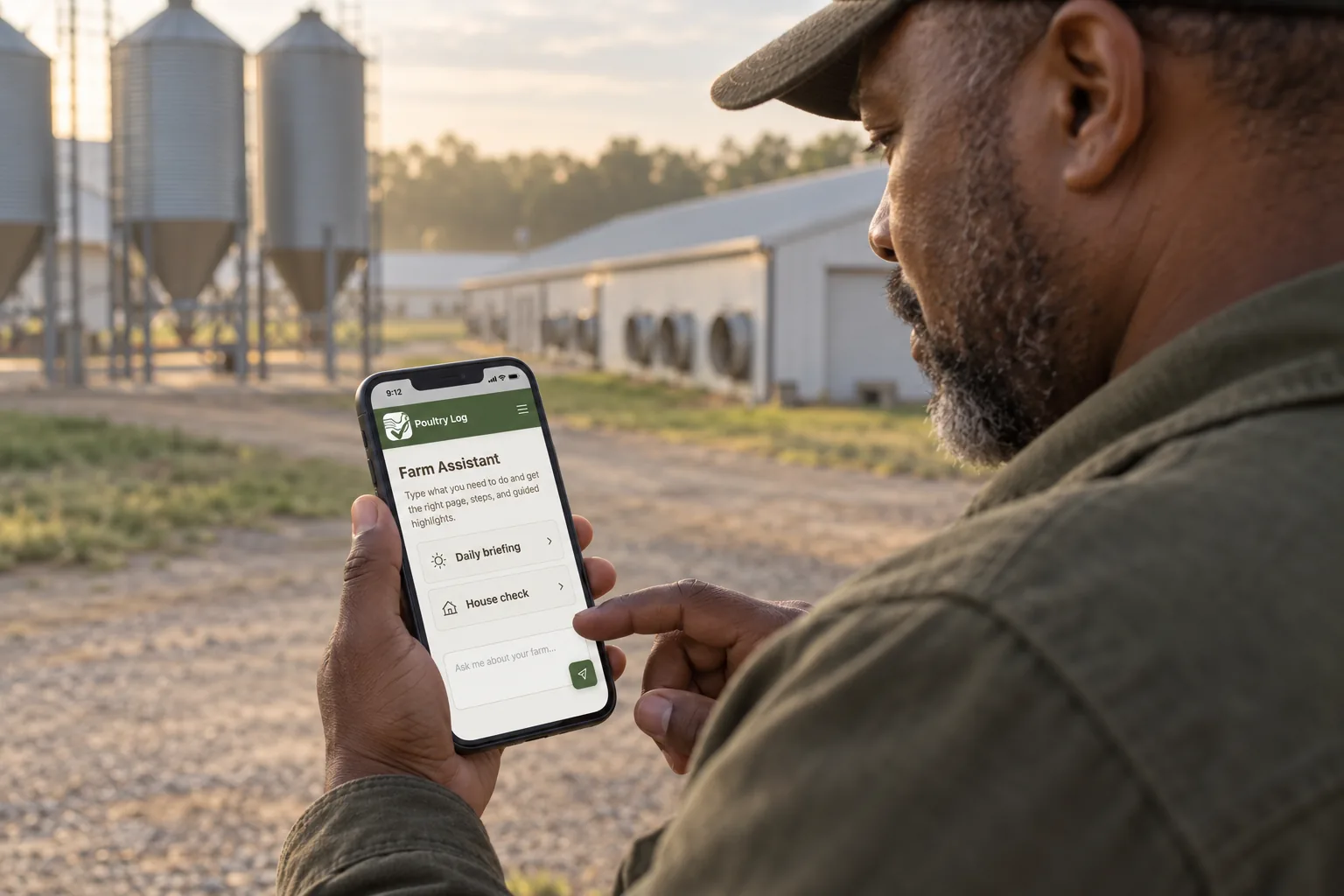
Poultry Log's Florida catalog carries these requirements with official source links and form templates, in the same workspace as the daily records that feed them. The mortality layer connects to the mortality and cull tracking guide, the egg layer to the wholesale egg dealer records guide, and the movement duties to the avian influenza testing guide. Confirm current requirements with FDACS and Florida DEP; completing a checklist does not certify legal compliance. Start free at poultrylog.com.
Frequently Asked Questions
What are Florida's limits for a limited poultry or egg operation?
Under Fla. Admin. Code r. 5K-4.033, a limited poultry operation may process no more than 20,000 own-farm birds per year and no more than 384 dressed birds per week, and a limited egg operation may keep no more than 3,000 hens and sell fewer than 30 dozen eggs per week. A food permit and initial inspection are required, and the permit does not authorize wholesale, mail-order, broker or dealer sales or interstate poultry sales.
When does a Florida egg or poultry business need a dealer permit?
Under Fla. Stat. ss. 500.12, 583.01, and 583.09, a dealer includes a covered business selling or handling 30 dozen or more eggs per week or more than 384 dressed birds per week, and must hold the applicable food permit. Covered dealers keep two years of invoices, manifests, bills of lading, and transaction records under Fla. Stat. s. 583.10.
How long is a Florida poultry import permit valid?
The Poultry Log Florida catalog records that a poultry import permit is valid for 15 days, under Fla. Admin. Code r. 5C-3.012. Domestic fowl, poultry, and hatching eggs entering Florida generally need prior permission plus an OCVI or NPIP VS Form 9-3 and the applicable Pullorum-Typhoid and avian-influenza evidence before entry.