
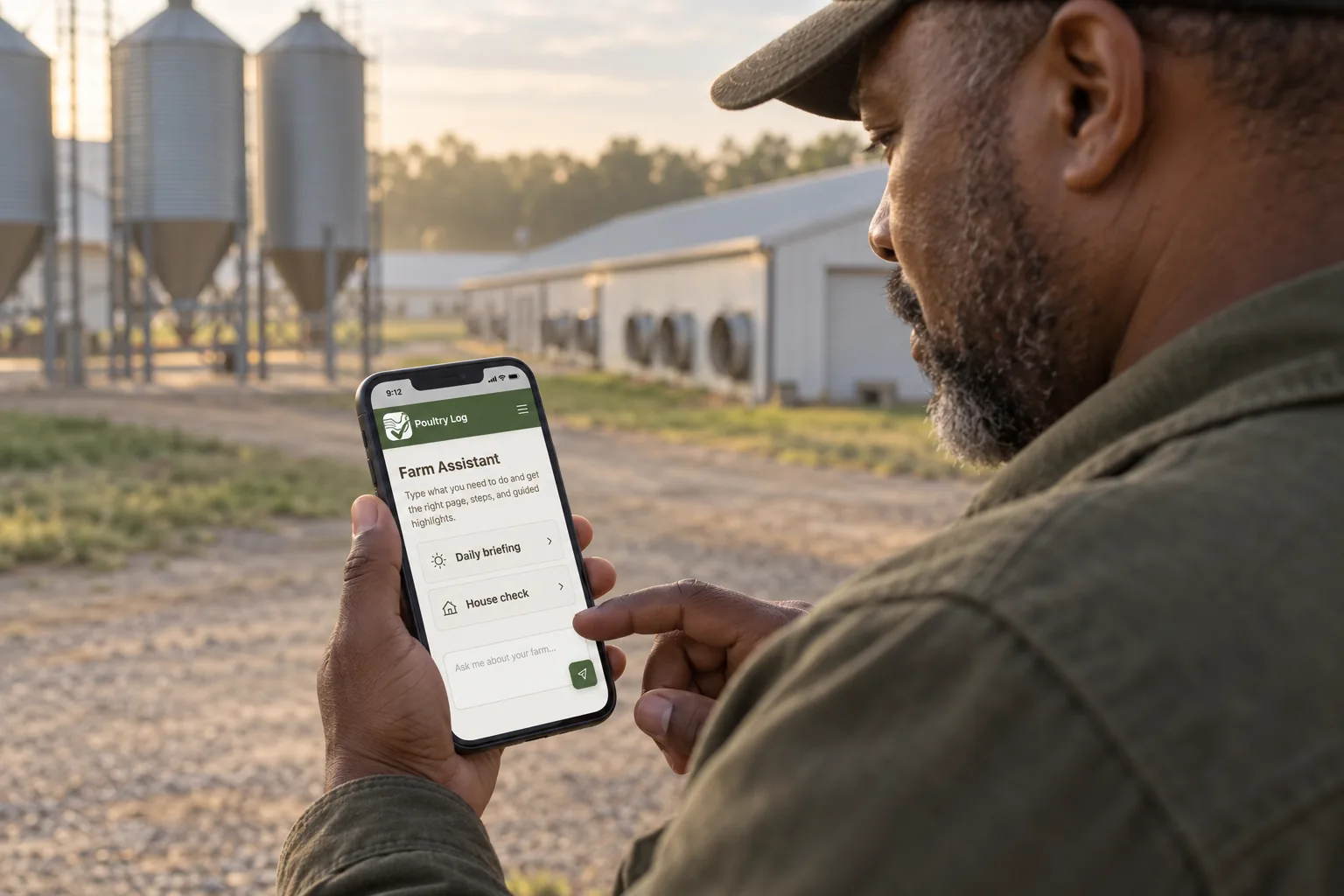
Backyard flocks are poultry — but they are not broilers, and the software that serves a 30,000-bird contract operation is rarely the right tool for twenty birds behind a house. A backyard keeper's software needs are real though: health records for the vet, cost tracking that shows what the flock actually costs, egg logs for laying hens, and a record that survives a predator event or a disease question. This page covers what backyard poultry software demands, what to verify in any tool, and an honest note on where commercial-broiler tools like PoultryLog™ fit — and where they do not.
What Does Backyard Poultry Software Demand?
| Demand | Why It Matters Backyard-Scale | What to Verify in Any App |
|---|---|---|
| Simple health and treatment records | A vet asked "when was she treated, and with what?" is the moment records matter — backyard keepers see vets rarely and need the history when they do | Log a treatment with product and date; confirm it retrieves later |
| Egg logs for laying flocks | Daily or weekly egg counts are the production signal — and the number that tells you when a hen stops paying her feed | Confirm egg counting exists as a native feature, not a workaround |
| Cost tracking at small scale | Feed, bedding, coop repairs — small numbers that add up; knowing cost per dozen eggs is what separates a hobby from a paying flock | Record feed costs; check whether cost per bird or per dozen computes |
| Mortality and predator records | Losses happen; dated records distinguish disease patterns from one-off predator events — and inform the next coop decision | Log a loss with date and suspected cause; confirm retrieval |
| Low friction, honest pricing | Backyard keepers will not tolerate enterprise complexity or enterprise pricing for six hens | Check what the free tier includes and what the entry price actually covers |
What to Verify Before You Commit
- Check the scale question first: does the tool model backyard flocks naturally, or does it force commercial assumptions (houses, placements, catch records) you will never use? Friction from irrelevant structure kills the habit.
- Verify egg logging exists if you keep layers — many poultry apps are broiler-focused and skip production tracking entirely.
- Run the treatment-record drill: log one treatment, retrieve it a week later. This is the record that matters most at the vet's office.
- Read the pricing at your scale: the free app guide covers what free tiers include — for a backyard flock, a capable free tier may be the honest answer.
Where PoultryLog™ Fits — and Where It Does Not
PoultryLog™ is built for commercial broiler operations — contract growers and independent broiler producers running houses at scale, with settlement records, integrator compliance, and breeder-curve tracking as its core. Its data model assumes houses, placements, and catch records; for a backyard flock, that structure is friction rather than value, and the honest recommendation is to evaluate tools built for your scale against the criteria above. The buyer's guide segmentation table shows which category fits backyard keepers and mixed small farms — start there, not with a commercial tool's marketing page. If your "backyard" operation is growing toward commercial scale, the same guide's contract-broiler row describes what you will eventually need.
Where the Money Shows Up
Backyard scale has its own economics: a laying hen that stops producing still eats every day, so cost per dozen eggs — feed plus bedding plus costs, divided by eggs collected — is the number that tells you whether the flock pays. Predator losses and disease events have their own costs: a dated mortality record is what turns "we lost some birds" into a pattern you can prevent. The scale changes the arithmetic, not the principle: records that connect what you spent to what the flock produced are what make the difference — the same principle the profitability guide applies at commercial scale.
- Poultry management software buyer's guide — parent evaluation framework with segment table.
- Best free poultry app — what free tiers actually include.
- Best poultry farm apps 2026 — the dated category comparison.
- 2026-10-05: Comprehensive rewrite. Segment demand table, verification drill, and honest scale positioning — replacing the earlier self-ranking version with unverified competitor claims.
- Earlier version: "best app" ranking with unverified competitor claims.