
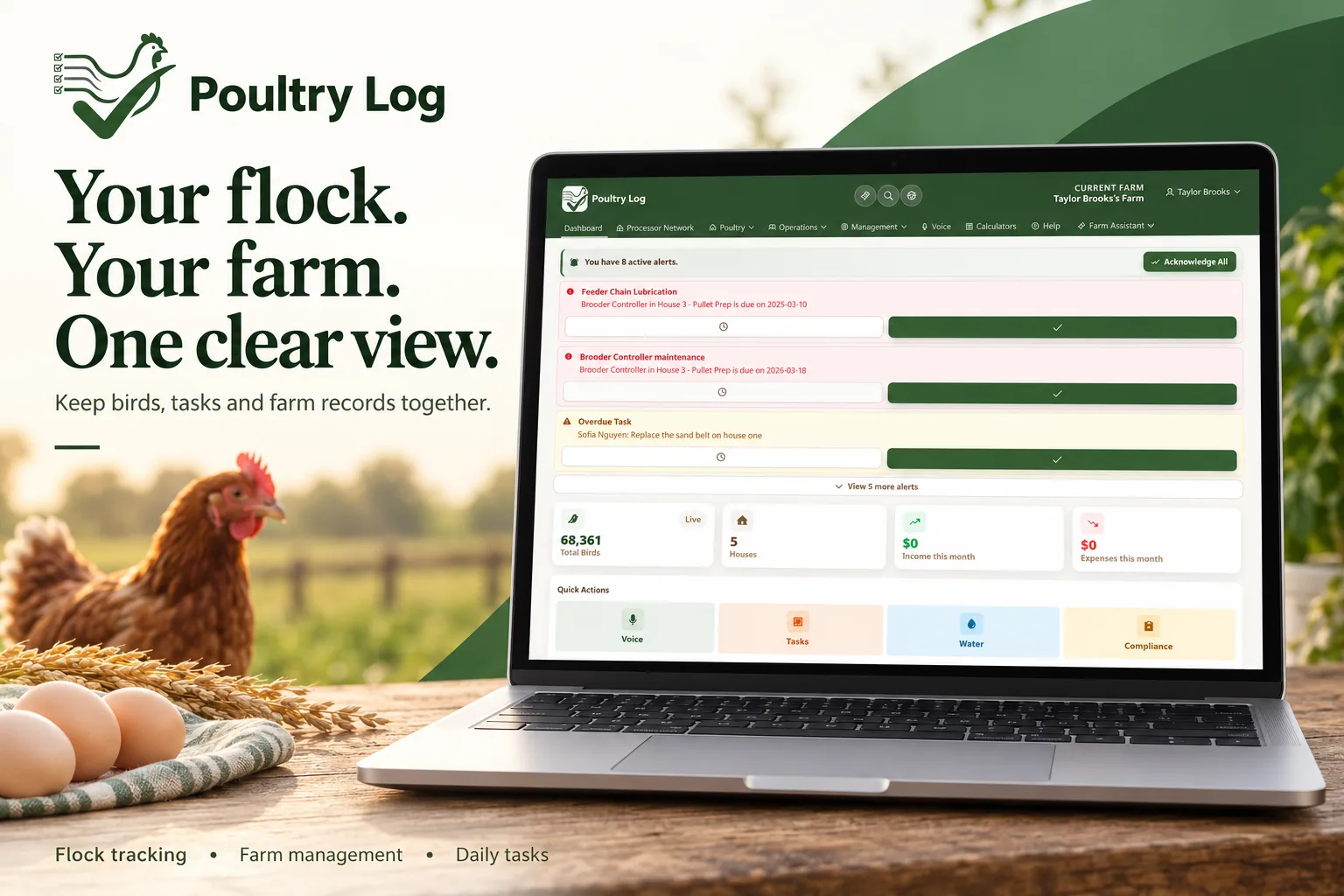
Ohio's poultry compliance program runs through three agencies that keep separate files: the Ohio Department of Agriculture Division of Animal Health for bird health and movement under Ohio Rev. Code Chapter 941, the ODA Food Safety program for eggs and processing under Chapter 911, and the Ohio EPA Division of Surface Water for CAFO coverage under Ohio Adm. Code Chapter 3745. Each layer carries its own cadence and retention rule. Poultry Log's Ohio catalog records each requirement with its agency, authority, trigger, retention period, and official source link, reviewed against the ODA and Ohio EPA program portals.
Animal Health Layer: ODA Division of Animal Health
- Importation - poultry, hatching eggs, or other fowl entering Ohio must meet ODA importation and health requirements under Ohio Rev. Code §§ 941.01 to 941.99 and Ohio Adm. Code Chapter 901:1, including a permit or certificate of veterinary inspection and any NPIP or Pullorum-Typhoid evidence required for the class of bird.
- Exhibitions - poultry exhibited at an Ohio show must originate from a Pullorum-Typhoid-clean or NPIP-participating flock or have a negative test within 90 days of the event, enforced at check-in. NPIP program status can substitute for the separate test, but the documentation requirement still applies.
- Hatcheries and breeding flocks - an Ohio hatchery, chick dealer, or seller of hatching eggs must participate in the state poultry health program, keep source, lot, and testing records, and maintain Pullorum-Typhoid and NPIP documentation. Chicks, poults, or hatching eggs offered for sale must come from clean or NPIP-participating breeding flocks, tested at least annually, with reactors removed.
- Reportable disease and disposal - a suspected or confirmed reportable poultry disease event, including avian influenza, must be reported immediately to ODA. Carcasses must be disposed of promptly by an approved method under Ohio Rev. Code § 941.47 et seq. and Ohio EPA disposal requirements, with each event recorded with date, method, location, and counts.
Egg and Processing Layer: ODA Food Safety
Under Ohio Rev. Code Chapter 911 and Ohio Adm. Code Chapter 901:3-4, a person who grades, candles, packages, or sells eggs as a dealer must hold an Ohio egg dealer license, displayed at the point of sale, and meet grading, candling, refrigeration, and labeling requirements. A producer selling only eggs from their own hens, without purchasing eggs from others, may operate under the producer exemption, but eggs must still be clean, wholesome, and honestly represented, and graded eggs must be labeled with grade, size, packer name and address, and pack date, and refrigerated. For poultry processing, a producer must use a licensed or USDA-inspected establishment unless every condition of Ohio's on-farm or custom exemption is met, including processing only its own birds with the required labeling and annual bird limits, keeping slaughter and sales records.
Environmental Layer: Ohio EPA
A poultry operation that is a Concentrated Animal Feeding Operation must obtain NPDES or state CAFO permit coverage from the Ohio EPA Division of Surface Water before discharging or operating its waste management system, under Ohio Adm. Code Chapter 3745 and 40 CFR Part 122, implementing a nutrient management plan and keeping production-area and land-application records. The catalog records the below-threshold position explicitly: an operation under the large CAFO threshold (fewer than 125,000 broilers or pullets, or 82,000 laying hens without a wet handling system, or 55,000 turkeys in grow-out) that does not discharge is generally not required to hold a CAFO permit, though designation can change that. Records are kept for the period the permit requires, commonly five years, and covered CAFOs submit the annual report under 40 CFR 122.42(e)(4).
Where Poultry Log Fits
Poultry Log's Ohio catalog carries all three layers with official source links and form templates, in the same workspace as the daily records that feed them. The egg layer connects to the wholesale egg dealer records guide, the NPIP layer to the NPIP participation records guide, and the CAFO layer to the CAFO permit guide. Neighboring state deep-dives are covered in the Indiana guide and the Pennsylvania guide. Confirm current requirements with ODA and Ohio EPA; completing a checklist does not certify legal compliance. Start free at poultrylog.com.
Frequently Asked Questions
What permits do Ohio poultry farms need?
Ohio layers duties across agencies: the ODA Division of Animal Health for importation, exhibitions, hatcheries, breeding flocks, reportable disease, and carcass disposal under Ohio Rev. Code Chapter 941; ODA Food Safety for egg dealer licensing and producer processing exemptions under Chapter 911; and Ohio EPA for CAFO NPDES coverage under Ohio Adm. Code Chapter 3745. Poultry Log's Ohio catalog records each requirement with its agency and official source.
What are Ohio's CAFO thresholds for poultry?
The Poultry Log Ohio catalog records the below-threshold exemption as fewer than 125,000 broilers or pullets, or 82,000 laying hens without a wet handling system, or 55,000 turkeys in grow-out, under Ohio EPA's CAFO/NPDES program and 40 CFR Part 122. An operation below threshold that does not discharge is generally not required to hold a CAFO permit, though designation can require coverage.
Do Ohio egg producers need a dealer license?
A person who grades, candles, packages, or sells eggs as a dealer must hold an Ohio egg dealer license under Ohio Rev. Code Chapter 911 and Ohio Adm. Code Chapter 901:3-4. A producer selling only eggs from their own hens, without purchasing eggs from others, may use the producer exemption, but graded eggs must still be labeled and refrigerated.