

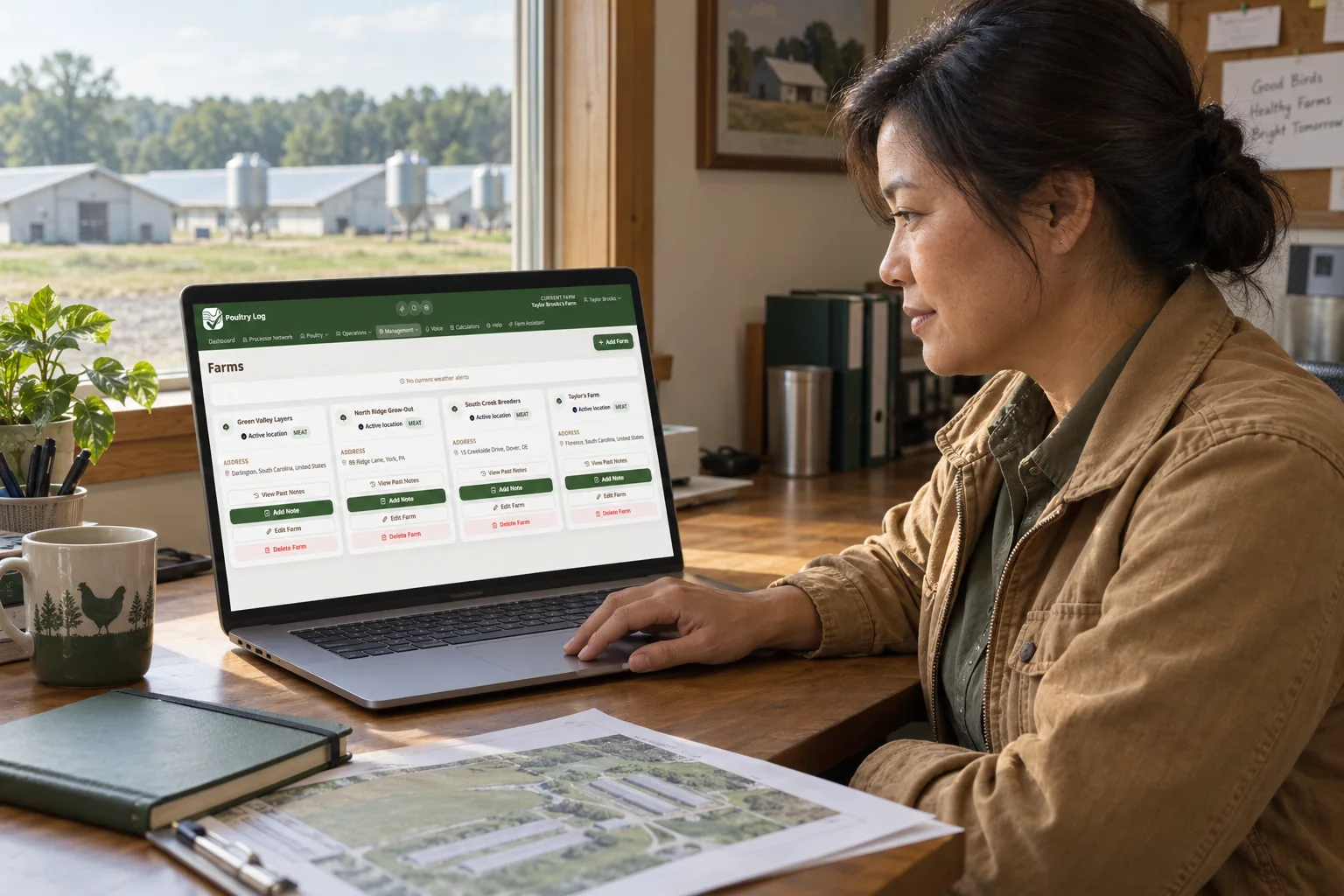
California's poultry compliance program is the most layered in the United States: egg handler registration with no small-flock exemption, Shell Egg Food Safety records, a 3,000-hen Salmonella Enteritidis prevention program, Proposition 12 certification, live-poultry transport records, processing authorizations, regional water board waste-discharge requirements, and air permits in the San Joaquin Valley. For California egg producers and poultry operations, Poultry Log's state catalog records each requirement with its agency, authority, cadence, retention, and official source link.
Egg Programs: Registration to Certification
- Egg handler registration - anyone producing, selling, donating, or otherwise handling shell eggs or egg products in California must register each location and renew annually, under California Food and Agricultural Code sections 27501-27690. The catalog records explicitly that CDFA states there is no small-flock or hobby exemption from registration.
- Shell Egg Food Safety records - enclosure, handling, marking, invoice, and production and supplier traceability duties under 3 CCR sections 1350, 1354, and 1358.4, with covered records kept three years from packaging.
- 3,000-hen SE prevention program - a registered producer or handler with 3,000 or more laying hens must implement and document FDA-aligned SE prevention, prescribed environmental monitoring, and an approved vaccination program, unless all shell eggs receive an approved 5-log treatment.
- Proposition 12 certification - shell and liquid eggs sold commercially in California must come from a certified compliant operation, with annual certification, on-site inspection, and audit-trail records kept at least two years.
Movement, Processing, and Mortality
Poultry and hatching eggs entering California must travel with a CVI, unless the flock is Pullorum-Typhoid Free and the shipment carries NPIP VS Form 9-3, under current CDFA entry requirements. Anyone transporting live poultry in California must carry a record identifying origin, destination, shipper, consignee, and kind and quantity, under California Food and Agricultural Code section 26603. Poultry slaughtered or processed for sale must operate under federal inspection, a CDFA poultry plant license, or a documented exemption whose conditions are met, with changes reported within 10 days. Off-farm mortality hauling requires a licensed vehicle taking carcasses to a licensed renderer or collection center, under sections 19320-19322.
Water, Air, and CAFO Coverage
California's environmental layer runs through the Regional Water Quality Control Boards rather than a single statewide program. A poultry confined animal facility that discharges or proposes to discharge waste that could affect state waters must obtain or document the applicable Regional Water Board waste-discharge requirement, waiver, or enrollment; the catalog records the Central Valley Poultry General Order R5-2016-0087-01 as the region's general instrument, and notes this is not an NPDES authorization for surface-water discharge. Discharging operations meeting federal CAFO thresholds obtain NPDES authorization from the applicable Regional Board. In the San Joaquin Valley, poultry confined animal facilities at or above 400,000 chickens or ducks, or 100,000 turkeys, must hold a Permit-to-Operate under SJVAPCD Rule 4570, maintain an approved emission mitigation plan, and keep quarterly inventory records, with records retained at least five years.
Where Poultry Log Fits
Poultry Log's California catalog carries these requirements with official source links and form templates, in the same workspace as the daily records that feed them. The egg program context is covered in the Shell Egg Rule records guide and the wholesale egg dealer records guide, the environmental layer in the CAFO permit guide, and the federal layer in the US integrator compliance records guide. Confirm current requirements with CDFA, your Regional Water Board, and your local air district; completing a checklist does not certify legal compliance. Start free at poultrylog.com.
Frequently Asked Questions
Do small egg producers need to register in California?
CDFA states there is no small-flock or hobby exemption from egg handler registration: anyone producing, selling, donating, or otherwise handling shell eggs or egg products in California must register each location and renew annually, under California Food and Agricultural Code sections 27501-27690.
What triggers California's 3,000-hen SE program?
A registered egg producer or handler with 3,000 or more laying hens must implement and document FDA-aligned SE prevention, prescribed environmental monitoring, and an approved vaccination program, unless all shell eggs receive an approved 5-log treatment, under 3 CCR sections 1350(c) and 1358.4(e).
Do California poultry farms need air permits?
In the San Joaquin Valley Air Pollution Control District, poultry confined animal facilities at or above 400,000 chickens or ducks, or 100,000 turkeys, must hold a Permit-to-Operate under Rule 4570 with an approved emission mitigation plan and quarterly inventory records. Other California air districts can impose separate source or equipment rules; confirm the applicable district for your location.